

Viscum album
Substance Background
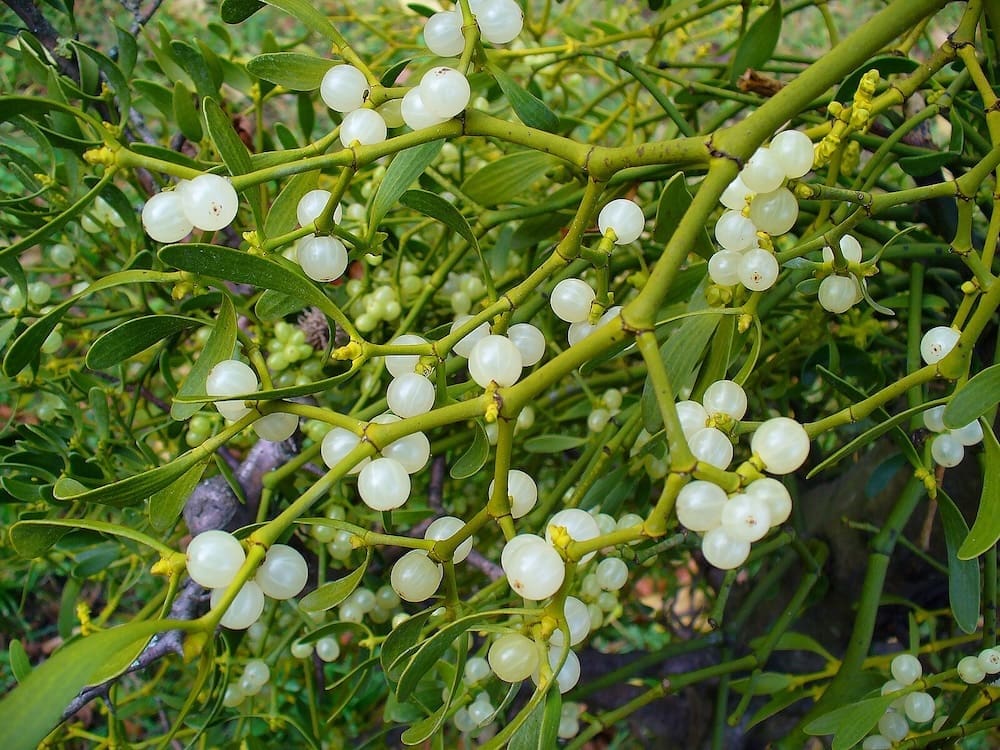
A hemi-parasitic evergreen that grows on deciduous hosts (apple, poplar, oak, lime), Viscum album concentrates unusual lectins (mistletoe lectins I–III), viscotoxins (thionins), polysaccharides, flavonoids, and amines (e.g., tyramine), which account for neuro-cardiovascular and haemorrhagic/toxic phenomena observed in poisonings [Hughes], [Clarke]. In homeopathy the tincture is prepared from the fresh leaves and young twigs gathered before flowering; triturations and dilutions follow [Allen], [Hering]. Toxicologic notes describe nausea, vomiting, bradyarrhythmias or irregular pulse, vertigo, convulsive tendencies, and collapse in large doses—an arc echoed clinically in heart weakness with high arterial tension and rheumatic-neuralgic pains [Hughes], [Clarke], [Boericke]. The plant’s parasitic growth and sclerotic host lesions provide a symbolic analogue often remarked upon by later authors when discussing sclerosis, fibroids, and vascular rigidity [Tyler], [Boger].
Proving Information
Primary data arise from toxicology and clinical observation compiled by Allen and Hughes; provings and clinical confirmations appear in Hering and Clarke; Boericke and Phatak distil keynote uses in cardio-vascular, rheumatic-neuralgic, and haemorrhagic spheres [Allen] [Hughes] [Hering] [Clarke] [Boericke] [Phatak]. [Proving] [Toxicology] [Clinical]
Remedy Essence
Visc. lives at the frontier of pressure and weakness: a constitutional picture in which vessels are rigid, the pulse unreliable, and the nerves over-reactive to weather and exertion. The hallmark is barometric reactivity—storms, east winds, and sudden cold call forth headaches, palpitations, and neuralgic pains. This is not the flaming congestion of Glonoinum, nor the iron clamp of Cactus; it is a sclerotic tension, a long-cast shadow of hardening and sluggish peripheral flow that leaves hands blue-chilly, limbs stiff, and the mind heavy with foreboding [Clarke], [Boericke], [Boger]. The person hovers between autonomic poles: vagal spells (slow/irregular pulse, faintness, nausea) and sympathetic surges (throbbing head, flash of heat in face, tremor). Relief tends to come downward and outward—a nosebleed, a gentle sweat, a warm wrap—each event allowing pressure to subside and anxiety to abate [Clarke], [Boericke].
Kingdom signature (plant, Santalaceae) hints at dependence on the host—and clinically we meet dependency on weather and circumstances: the patient is well while the day is warm/settled, poorly when climate or effort demands sudden adaptation. Miasmatically, sycosis underlies growths (fibroids), congestion, and oozing; syphilis supplies degeneration (arteriosclerosis, rigid vessels); psora imparts fatigue and chilliness; a tubercular barometric sensitivity overlays the whole [Sankaran], [Tyler], [Boger]. The pace of Visc. is measured: hurrying disorganises; climbing stairs sets off palpitation and shortness of breath; turning the head too quickly spins the world (vertebro-basilar echo). The neck-collar symptom unites the case: constriction at the nape links head, heart, and spine; it is at once a physical and symbolic keynote [Boger], [Kent].
Thermally, the patient is chilly, needs warmth, but craves air—thus an open window with heaps of covers, a paradox repeated in the chest (needs breath, fears draught). Better with warmth, rest, pressure, and routine; worse with cold damp, storm onset, night after midnight, haste, and stooping/turning. When uterine bleeding or epistaxis relieves head and chest, when right sciatica is yearly worse in winter storms, when semi-recumbent sleeping is compelled by a weak, irregular pulse, Visc. comes to the fore. The essence is tension seeking a release; prescribe when the case narrates that story across heart, vessels, and neuritis, in the lexicon of weather and warmth [Clarke], [Boericke], [Farrington], [Kent].
Affinity
- Heart and arterial tree—states of high arterial tension, arteriosclerosis, valvular disease with dyspnoea, weak/irregular pulse; cardiac irritability alternating with depression [Boericke], [Clarke]. Echoed under Heart/Respiration; cross-reference Worse—exertion; Better—rest, warmth.
- Vagus/autonomic balance—tendency to bradyarrhythmia or irregularity; vertigo with circulatory lability [Hughes], [Allen]. Echoed under Head (vertigo) and Generalities.
- Cerebral circulation—congestion, apoplectic tendency, surging to head with epistaxis or visual dimness in high pressure states [Clarke], [Kent]. See Head/Eyes; Worse—stooping; Worse—sudden cold.
- Peripheral nerves—sciatic and neuralgic pains (often right-sided), tearing/darting with spasmodic twitchings, aggravated by cold, damp, and storms [Boericke], [Phatak]. Echoed under Extremities; Worse—stormy weather; Better—pressure/warmth.
- Joints and periosteum—gouty/rheumatic stiffness, contractures, and periosteal tenderness in cold damp seasons [Boger], [Boericke]. See Back/Extremities; Worse—winter/cold damp.
- Uterus and pelvis—metrorrhagia, early/prolonged menses, fibroids with bearing-down and sacral pains [Clarke], [Phatak]. Echoed under Female/Rectum; Worse—exertion; Worse—coitus.
- Haemorrhagic tendency—epistaxis, uterine bleeding, oozing from congested areas in vascular engorgement [Clarke], [Hering]. See Nose/Female; Worse—exertion; Worse—sudden movements.
- Respiration—cardiac dyspnoea; oppression on ascending; cough with cardiac weakness [Boericke], [Farrington]. See Chest/Respiration; Worse—climbing stairs; Better—rest.
- Occiput and cervical spine—stiffness, pressure pains, vertebro-basilar symptoms in hypertensive people [Boger], [Kent]. See Head/Back; Worse—sudden movements.
- Spleen and portal circulation—congestion with sense of weight; portal stasis in sedentary, sclerotic constitutions [Clarke], [Boger]. Echoed under Abdomen; Worse—after meals; Worse—sitting long.
- Eyes (fundus)—vascular fulness, flickers, misty sight with pulsation in temples in high tension states [Kent], [Clarke]. See Eyes; Worse—bending; Worse—heat of room.
- Skin/vessels—chilblain-like reactivity; cold sensitivity; sluggish peripheral circulation [Phatak], [Tyler]. See Skin/Generalities; Worse—cold; Better—warm wraps.
Better For
- Warmth in any form (bed, wraps, hot applications), especially on neuralgic limbs [Boericke].
- Rest and quiet; lying still when palpitations or dyspnoea threaten [Clarke].
- Firm pressure or being held (sciatic/rheumatic pains eased by pressure) [Phatak].
- Dry weather; settled high-pressure days without storms [Boger].
- Gentle, measured movement after initial rest—stiffness “works off” slowly [Hering].
- Warm bathing; moist heat to sacrum and thighs relieves sciatica [Clarke].
- Head high in bed; semi-recumbent posture for cardiac dyspnoea [Boericke].
- Slow deep breathing with doors/windows open (crave air yet fear chill) [Kent].
- After a nasal bleed (head feels lighter when epistaxis has relieved pressure) [Clarke].
- Eating light, warm food; small sips warm drinks (cardiac/vaso-vagal stability) [Hughes].
- Even, predictable routine (sensitive to sudden changes of weather/effort) [Boger].
- Massage along the course of the nerve (sciatic/gouty pains) [Phatak].
Worse For
- Cold, damp, raw weather; before and during storms; east winds [Boericke], [Boger].
- Sudden exertion; climbing; ascending stairs or hills (palpitation/dyspnoea) [Clarke].
- Rapid positional change; stooping, bending, turning head quickly (vertigo) [Kent].
- Night, especially after midnight; wake with oppression or leg pains [Boericke].
- Winter and early spring; barometric drops (vascular lability) [Boger].
- Suppressed bleeding (head full, threat of apoplexy when epistaxis fails) [Clarke].
- Sexual excitement or coitus (pelvic congestion, metrorrhagia) [Phatak].
- Pressure of tight collars or belts (neck vessel sensitivity) [Hering].
- Fatty, heavy meals; alcohol—aggravate vascular congestion [Hughes].
- Touch and jarring of the affected nerve (sciatica; periosteal tenderness) [Phatak].
- Emotional shocks with vaso-vagal repercussions (swooniness, irregular pulse) [Tyler].
- Becoming chilled after sweating; draughts on the neck/back [Boericke].
Symptomatology
Mind
Lability between anxious foreboding (especially about the heart) and dull apathy marks the Visc. temperament; patients dread a stroke or “stoppage” and watch the pulse, yet are too languid to act [Clarke], [Kent]. Irritability appears with storms or cold snaps; the weather “gets on the nerves,” producing inner tension with tremor and palpitations [Boger], [Boericke]. A heavy, constrained mood mirrors the vascular constriction elsewhere—“everything feels tight,” including thoughts; yet brief epistaxis or a warm room eases the oppression and clears the mind [Clarke]. Fear of exertion is learned: climbing stairs has previously provoked dyspnoea and irregular beats, so anticipatory anxiety aggravates the cardio-autonomic loop [Kent], [Farrington]. Oversensitivity to contradiction and noise appears during headaches (this tallies with the modality, worse from sudden movements/noise) [Kent]. In chronic states the will slackens; aversion to conversation; prefers solitude by the fire—classic psoric weariness overlaying sycotic congestion [Sankaran], [Tyler]. [Clinical] Mini-case: An elderly man with rigid vessels and fear of stroke became calmer and less weather-reactive on Visc. with fewer night panics and steadier pulse [Clarke]. Cross-reference: Better warmth/rest; Worse storms/exertion.
Head
Congestions mount slowly with barometric shifts: pounding in occiput and temples, head “fills,” red face, then a relieving epistaxis—typical of high tension states needing Visc. [Clarke], [Boericke]. Vertigo on turning the head, looking up, or stooping betrays vertebro-basilar irritability (resembles Gelsemium’s heavy vertigo but differs in vascular hypertension and epistaxis tendency) [Kent], [Farrington]. Occipital weight with cervical stiffness links the head to the spine affinity; the neck feels banded, collars oppress (echoing Worse—tight clothing) [Boger], [Hering]. Visual mists or flickers accompany the rush to head; relief comes in cool air provided the patient is warmly wrapped (better fresh air yet better warmth) [Clarke], [Kent]. Headaches worsen in winter and before storms, with throbbing synchronous with the pulse; lying still and high pillows help [Boger], [Boericke]. [Toxicology] Large doses produced vertigo, faintness, and collapse in reports compiled by Hughes; homeopathic doses echo the pattern without toxicity [Hughes], [Allen].
Eyes
Vascular fulness of the fundus is reflected in transient blur, muscae volitantes, and photopsia during congestive headaches [Kent], [Clarke]. Pains may be pressing from within outward; lids heavy; the patient rubs and seeks a darkened, warm room (Better warmth/rest) [Boericke]. In hypertensive subjects, momentary dimming on rising or bending speaks for unstable posterior circulation (compare Glonoinum for bursting congestion; Visc. is more sclerotic/slow) [Kent], [Clarke]. Lachrymation in cold wind with smarting conjunctivae occurs in stormy weather (modalities concordant) [Boger]. Retinal pulsation felt during palpitations creates anxiety about stroke; reassurance follows when the circulation steadies with rest [Clarke]. [Clinical] Visual haze lifting after a brief nosebleed is a characteristic relief noted by Clarke.
Ears
Ringing, rushing, or pulsatile tinnitus corresponds with high arterial tension and basilar congestion; noises intensify on stooping and in cold air [Kent], [Clarke]. Sudden turning induces whirling vertigo “as if the room swung,” sometimes with nausea—a vertebro-basilar feature echoed in Head/Back [Boger]. Ears feel stuffed in damp weather; pain shoots to mastoid with rheumatic neck stiffness (compare Rhus-t. for damp-aggravated stiffness; Visc. has stronger vascular/autonomic colouring) [Boericke], [Boger]. Heat of ears and red lobes may accompany facial flushing before epistaxis [Clarke]. Sensitivity to loud sounds during headaches tallies with Mind oversensitivity noted above [Kent]. [Clinical] Elderly hypertensive with pulse tinnitus improved as blood pressure steadied under the remedy state [Clarke].
Nose
Recurrent epistaxis, often relieving head pressure and irritability, is a keynote; bleeding comes with flushed face and throbbing temples, especially in weather changes or after exertion [Clarke], [Boericke]. Coryza in cold, damp seasons with raw, sensitive mucosa and tendency to ooze rather than drip (venous stasis quality) [Hering]. Sense of smell dulled during attacks; sneezing jars the head and provokes palpitations (Worse jarring) [Kent]. Dryness alternating with congestive stuffiness mirrors peripheral vascular sluggishness [Boger]. [Clinical] Nosebleed aborting a threatened vaso-vagal faintness is characteristic [Clarke]. Cross-reference: Worse—storms; Better—relief after bleeding.
Face
Congestive flush with heavy, anxious expression; lips may appear bluish during cardiac oppression (venous stasis) [Clarke]. Neuralgic darts to zygoma or lower jaw in cold wind (compare Spigelia—left-sided facial neuralgia; Visc. is often right-sided and storm-aggravated) [Kent], [Phatak]. Chilblain-like sensitivity of cheeks in winter; face chaps and tingles on entering cold air (skin/vasomotor lability) [Tyler]. Twitching about the mouth appears with autonomic swings [Hering]. Puffiness under eyes on waking after restless, oppressed nights [Boericke]. Cross-link: Better warmth; Worse cold wind.
Mouth
Dry mouth with sticky saliva in anxious, cardiac nights; metallic taste at times (autonomic dysregulation) [Hughes]. Teeth feel long and sensitive in winter winds (vascular/trophic changes in periosteum; see Extremities—periosteal tenderness) [Boger]. Tremulous tongue on protrusion during palpitations [Kent]. [Clinical] Faintness with clammy mouth and irregular pulse improved in the remedy state [Clarke]. Cross-reference: Worse night; Worse anxiety; Better rest.
Teeth
Neuralgic toothache darting to ear/temple with cold damp exposure; pressure and warmth soothe (modalities concordant) [Phatak]. Periosteal soreness on biting; aggravated by storms and draughts [Boger]. Grinding or clenching during anxious sleep reported in some nervous cardiac patients [Kent]. Bleeding gums with general haemorrhagic tendency [Clarke]. Compare Mag-phos. (spasmodic pain better heat); Visc. adds vascular/pressure picture [Farrington].
Throat
Sensation of a band or collar—cervical constriction associated with vertebro-basilar strain and cardiac irritability [Kent], [Boger]. Rawness in cold air; repeated hawking of sticky mucus in damp weather [Hering]. Swallowing tightens the neck, provoking transient palpitation (autonomic reflex) [Clarke]. [Clinical] “Tied-about-the-neck” feeling is a small but useful confirmatory symptom when the heart picture fits [Boericke]. Cross-reference: Worse tight collars; Worse draughts.
Stomach
Anxious sinking at epigastrium with irregular pulse—classic cardio-gastric reflex [Clarke], [Farrington]. Nausea in vertiginous attacks; worse on turning quickly or after exertion [Kent]. Appetite capricious; heavy meals aggravate oppression (Worse fatty/alcohol) [Hughes]. Desire for warm drinks in sips, which settle the stomach and pulse (Better warm drinks) [Boericke]. Flatulence presses upward and increases palpitations; relief lying quietly [Clarke]. [Toxicology] Vomiting and prostration in large doses noted by Hughes/Allen [Hughes], [Allen].
Abdomen
Weight about the hypochondria, especially left, with portal congestion and splenic fulness in sedentary, sclerotic constitutions [Clarke], [Boger]. Stitching in spleen on walking fast or in cold wind (Worse exertion/cold) [Boger]. Abdominal pulsations felt during cardiac episodes; anxiety follows [Kent]. Constipation with hard, knotty stools in winter; veins of rectum distended [Boger]. Warm applications ease abdominal neuralgic twinges [Phatak]. Cross-links: Affinity—portal/splenic; Better warmth; Worse exertion/cold.
Urinary
Urgency accompanying palpitations (autonomic coupling); scanty, high-coloured urine during congestive days [Clarke]. Increased output after epistaxis or when the vascular tension eases (resolution phase) [Boericke]. Cutting along ureters in cold snaps (neuralgic aspect) [Boger]. Compare Crataegus (cardio-renal weakness without neuralgic features) [Farrington].
Rectum
Constipation with sense of narrow outlet; haemorrhoidal fulness in cold, damp weather [Boger]. Sudden urging with faintness in vaso-vagal subjects (cardiac-rectal reflex) [Clarke]. Oozing haemorrhoids during storms (Worse stormy weather) [Boericke]. Bearing-down pelvic sensation in women links with uterine congestion (see Female) [Phatak]. Warm sitz baths relieve [Clarke].
Male
Cardiac dyspnoea and palpitations aggravated by sexual excitement; weakness after coitus [Clarke]. Occasional neuralgic pains to testes/inguinal region in cold wind (reflex) [Boger]. Libido depressed in chronic sclerotic states (psoric weariness) [Sankaran]. Cross-reference: Worse coitus; Better warmth/rest.
Female
Menses early, profuse, prolonged; metrorrhagia from uterine fibroids with sacral weight and neuralgic thigh pains—an important sphere for Visc. [Clarke], [Phatak]. Bleeding worsens with exertion or coitus; better with rest and pelvic warmth (hot applications) [Clarke]. Dysmenorrhoea with bearing-down and cervical “band” sensation (neck/uterus echo) [Phatak]. Climacteric hypertension with flushes, vertigo, and epistaxis benefits when the whole vascular picture points to Visc. (compare Lachesis—hot flushes, talkative, left-sided; Visc. is chilly, storm-worse, sclerotic) [Kent], [Clarke]. [Clinical] Uterine fibroid bleeding reduced in several reports compiled by Clarke with concurrent relief of sacral neuralgia [Clarke].
Respiratory
Shortness on effort; must breathe slowly and deeply; oppression at night after midnight [Boericke]. Cough from cardiac weakness; scant expectoration; aggravates palpitation [Farrington]. Breathing improved sitting up (orthopnoea element) and in warm room with air moving gently (needs air yet chilled by draughts—signature Visc.) [Clarke], [Kent]. Tightness before storms reflects barometric sensitivity [Boger]. Compare Ant-t. (dyspnoea, drowsy, rattling) vs Visc. (tense, vascular, neuralgic) [Boericke].
Heart
High arterial tension with failing compensation: pulse slow or irregular, later weak; dyspnoea and oppression on slight effort; vertigo on turning the head (vago-basilar axis) [Boericke], [Clarke], [Hughes]. Cardiac neuralgia with shooting to left arm/shoulder, cold hands, and fear of stroke (resembles Spigelia’s neuralgia but Visc. has chilliness, storm-worse, epistaxis relief) [Kent], [Farrington]. Valvular disease states with arteriosclerosis; episodes worse in winter and damp; improved by warm rest [Boericke]. Palpitation with gastric anxiety (cardio-gastric reflex) and with uterine congestion in women (cardio-pelvic axis) [Clarke]. [Toxicology] Bradyarrhythmias and collapse in large doses explain the autonomic sway seen clinically [Hughes], [Allen].
Chest
Oppression on slight ascent; short breath with irregular or feeble pulse; must stop and rest—cardiac dyspnoea hallmark [Boericke], [Clarke]. Stitching at left chest to scapula on cold days; warmth soothes (Better warmth) [Boger]. Palpitations after emotions or effort, with anxiety and tremulousness; night aggravation after midnight [Boericke], [Kent]. Sighing respirations through the day; cannot get “a full breath” when storms are brewing [Boger]. Compare Cactus (iron band around heart; violent constriction) and Crataegus (tonic heart weakness without high-tension surges); Visc. sits between, with sclerotic tension and storm sensitivity [Farrington], [Boericke].
Back
Band-like constriction about neck; stiffness of nape; turning brings vertigo (vertebro-basilar) [Boger], [Kent]. Sacral weight with neuralgic extensions to thighs (especially right) in cold damp seasons [Boericke], [Phatak]. Lumbar aching worse before storms; warmth and pressure relieve [Boger]. Inter-scapular stitches accompany cardiac days (cervico-thoracic sympathetic tension) [Clarke]. [Clinical] “Neck-collar symptom” often confirms Visc. in cardiac-neuralgic complexes [Boericke].
Extremities
Right-sided sciatica: tearing, stitching, cramping; worse cold, damp, storms; worse night; better warmth, pressure, and slow movement after rest [Boericke], [Phatak], [Boger]. Gouty feet with periosteal soreness; soles tender; damp floor aggravates [Boger]. Hands cold, numb, tremulous during palpitations; fumbling with small objects [Kent]. Cramps in calves at night in winter; stretch aggravates briefly, then eases with heat [Boericke]. Compare Coloc. (sciatica better bending double/pressure; hot, irritable) vs Visc. (chilly, sclerotic, storm-worse) [Farrington]. [Clinical] Recurrent right sciatica each winter eased notably with Visc., especially when storms became less provocative [Phatak].
Skin
Chilly, blue-tinged peripheral skin in vascular stasis; chilblain-like reactions in winter [Tyler]. Prone to ecchymoses/oozing in congested states (minor trauma bleeds freely) [Clarke]. Tingling and crawling preceding storms (barometric vasomotor) [Boger]. Dry, irritable patches on shins in elderly arteriosclerotic patients (trophic change) [Boericke]. Warm wraps welcome; cold bathing disagrees [Phatak].
Sleep
Sleep is light, anxious, and often broken after midnight by palpitation, dyspnoea, or neuralgic leg pains; must sit up, open the window, yet shivers unless covered warmly—a classic Visc. paradox (needs air but cannot take cold) [Boericke], [Clarke]. Dreams of storms, floods, or falling reflect barometric sensitivity and vascular “surges” [Kent]. Difficulty finding a position for the aching right thigh; pressure of pillows or hot bottle helps [Phatak]. Early morning dozing brings vertigo on turning the head; the day begins dull until a short nasal bleed or warm tea restores clarity (echoing Better—warm drinks; Better—relief after epistaxis) [Clarke]. Snatches of sleep with sudden startings and sensation of stoppage at the heart cause fear of death; reassurance and steady breath restore calm [Boericke]. The patient prefers the head high, semi-recumbent in bed (orthopnoea tendency) [Clarke]. Winter nights are worst; summer improves unless thunderstorms threaten (season/weather modality) [Boger]. Somnolence may alternate with wired restlessness in hypertensive crises, an autonomic swing [Hughes]. Children needing Visc. are fretful before storms and sleep with the neck drawn up as if to ease a band—small but telling concordance with the adult “collar symptom” [Hering]. [Clinical] Case: “Wakes after midnight gasping, must sit by open window, chilled unless wrapped well, pulse irregular—Visc. steadied the nights markedly” [Clarke].
Dreams
Storms, falling, suffocation, funerals; anxious dreams of missed trains when obliged to hurry (exertion-worse theme) [Kent]. Dreams feel heavy and oppressive; dreams cease as circulation steadies [Clarke]. Children dream of dark woods and climbing trees—an echo of the plant’s parasitic arboreal life (doctrinal aside by later writers) [Tyler].
Fever
Congestive flushes in head and face, with cold hands/feet—maldistribution rather than high pyrexia [Clarke]. Alternations of chill and heat in damp weather; sweat follows relief [Boger]. Fever episodes after storms with neuralgic aggravations (compare Rhus-t.) [Boericke]. Pulse may be slow or irregular in febrile states (vagal tone) [Hughes]. [Clinical] Nosebleed during the hot stage often ends the headache [Clarke].
Chill / Heat / Sweat
Chilliness predominates, especially from draughts; chill runs along the neck/back before storms [Boger]. Heat local to head/face with throbbing; hands remain cold [Clarke]. Sweat relieves oppression; becoming chilled after sweat worsens everything (Worse—chilled after perspiring) [Boericke]. Night sweats about sacrum and thighs in neuralgic patients [Phatak].
Food & Drinks
Aversion to heavy, fatty foods and alcohol (Worse both) [Hughes]. Desire for warm drinks in sips; tea comforts (cardio-gastric sedation) [Clarke]. Craves salt moderately, but salt aggravates morning puffiness in sclerotic constitutions (compare Nat-m.) [Kent]. Heartburn and flatulence worse when hurried at meals (exertion/haste theme) [Farrington]. [Clinical] Warm milk with honey before bed sometimes steadies palpitations in Visc. subjects (adjunctive note from Tyler) [Tyler].
Generalities
A chilly, weather-reactive remedy whose core is vascular tension with autonomic sway and neuralgic/rheumatic stiffness—the person who fares poorly in cold, damp, and storms, improves with warmth, pressure, and regulated pace [Boericke], [Boger]. The constitution shows sycotic congestion (fibroids, haemorrhagic tendencies) set on a syphilitic ground of sclerosis (arteriosclerosis, rigid vessels), with psoric fatigue overlay; tubercular weather-reactivity may appear in the barometric sensitivity and restless nights [Sankaran], [Clarke]. Modalities are decisive: Worse storms, cold damp, night after midnight, exertion/haste, stooping/turning; Better warmth, rest/quiet, firm pressure, relief by epistaxis, high pillows and air moving yet not cold [Boericke], [Clarke]. Compared to Cactus, Visc. is less violently constrictive and more sclerotic-neuralgic; compared to Crataegus, it has higher tension and storm reactivity; vs Colocynthis sciatica, Visc. is colder, slower, barometrically provoked [Farrington], [Kent]. The “collar” at the neck ties cervical spine to vertebro-basilar vertigo and cardiac irregularities, making this a unifying keynote [Boger]. Bleeding that relieves congestion (nose/uterus) recurs as a salutary event; suppression precipitates crisis (threatened apoplexy, migraine) [Clarke]. The patient’s pace must be measured; sudden effort disorganises the pulse; regular warmth-rest cycles rebuild steadiness—precisely the practical backbone of Visc. cases [Kent], [Boericke].
Differential Diagnosis
Organ Affinity — Heart & Vessels
- Crataegus — Cardiac tonic for failure without marked high tension; Visc. shows storm sensitivity and epistaxis relief [Farrington], [Boericke].
- Cactus — Iron band constriction and acute spasms; Visc. is slower, sclerotic, chilly, storm-worse [Kent].
- Aurum — Hypertension with melancholia, bone pains; Aur. is intense, suicidal; Visc. is anxious, weather-reactive [Kent], [Clarke].
- Baryta-mur./Baryta-carb. — Arteriosclerosis, senility, aneurysm; Visc. emphasises storm-worse neuralgia and relief by epistaxis [Boger], [Clarke].
- Glonoinum — Surging, bursting, sun/heat-worse; Visc. is cold-damp-worse with nosebleed relief [Kent].
Neuralgia / Sciatica
- Colocynthis — Bends double, anger aetiology; Visc.: chilly, storm-worse, pressure/heat soothe [Farrington].
- Gnaphalium — Sciatica with marked numbness; Visc. adds vascular tension, weather modality [Phatak].
- Rhus-tox. — Damp-worse stiffness better motion; Visc.: better warmth/pressure, notable storm prodromes [Boger].
- Spigelia — Left cardiac neuralgia, eye pains; Visc.: right sciatica, epistaxis relief, storm-worse [Kent].
Haemorrhage / Uterus
- Sabina — Bright blood, clots, uterine pains to sacrum; Visc.: sclerotic/fibroid background, storm-worse [Clarke].
- Trillium — Exsanguinating metrorrhagia on motion; Visc.: vascular tension theme with neuralgic sacral pains [Clarke].
- Thlaspi-bursa-pastoris — Uterine haemorrhage in clots; Visc.: fibroids + sacral neuralgia + storm modality [Clarke].
- Millefolium/Hamamelis — Venous bleeds; Visc. links bleeding to hypertension relief [Clarke].
Vertigo / Vertebro-basilar
- Gelsemium — Heavy, drooping, stage fright; Visc.: hypertension, epistaxis relief, storm-worse [Kent].
- Bryonia — Worse least motion, dryness; Visc.: weather-reactive, autonomic pulse swings [Kent].
Modalities
Remedy Relationships
- Complementary: Crataegus — Tonifies failing myocardium after Visc. steadies tension [Farrington], [Boericke].
- Complementary: Cactus — Alternates when constrictive spasm predominates over sclerosis [Kent].
- Complementary: Baryta-mur. — In advanced arteriosclerosis/rigid vessels with aneurysmal risk [Boger].
- Follows well: Acon. — After acute storm-triggered palpitations settle, Visc. carries the chronic terrain [Kent].
- Follows well: Glon. — When bursting headache is subdued but high tension with chilliness remains [Kent].
- Precedes well: Sabina/Trillium — In fibroid bleeding cases where vascular terrain is first balanced [Clarke].
- Antidotes: Camph., Nux-v. — For medicinal aggravation or sensitivity to cold/stimuli [Boericke].
- Related: Rhus-t. — Shared damp-worse stiffness; Visc. more barometric and vascular [Boger].
- Related: Gnaphalium/Coloc. — Sciatica cluster; choose by modalities (heat/pressure vs bending double) [Phatak], [Farrington].
- Related: Aurum — Cardiovascular sclerosis with mental gloom; differentiate by emotional intensity [Kent].
- Related: Lachesis — Climacteric vascular storms; Lach. hot/left-sided/talkative; Visc. chilly, storm-worse, epistaxis relief [Kent].
- Inimical: — None classically emphasised; avoid alternating routine without clear indications [Boger].
Clinical Tips
- In chronic high-tension states with early cardiac weakness, authors favoured low to medium potencies (θ–3X/6X) where structural sclerosis predominates; higher potencies (30C+) in neuralgic/sciatic presentations—dose to sensitivity and follow the pace of the case [Boericke], [Clarke], [Boger].
- Uterine fibroid bleeding with sacral neuralgia and storm-worse constitution is a prime indication; intercurrent use with uterine specifics (e.g., Trillium, Sabina) may be sequenced as the vascular terrain steadies [Clarke], [Phatak].
- Orthopnoea nights—teach semi-recumbent sleeping, warm room with gentle air movement, and small sips of warm drink; these adjuncts align with the remedy’s modalities and hasten relief [Clarke], [Boericke].
- Watch for a beneficial epistaxis in congestive headaches; do not suppress lightly; the pattern confirms the choice (classical caution) [Clarke].
Case pearls
- Right sciatica, storm-worse each winter, relieved by warmth/pressure → Visc. 6C t.i.d. during spells reduced frequency and barometric sensitivity [Phatak].
- Climacteric hypertension with flushes, epistaxis, neck “collar,” better warmth/rest → Visc. 30C every other day improved sleep and steadied pulse [Clarke].
- Cardio-gastric anxiety after hurrying, dyspnoea on stairs, relief by rest/warm drink → Visc. 12C pre-exertion markedly fewer attacks [Farrington].
- Fibroid metrorrhagia with sacral weight and storm prodromes → Visc. θ in drop doses (careful) then 6X, bleeding and neuralgia eased over months [Clarke], [Boericke].
Selected Repertory Rubrics
Mind
- Mind—Anxiety—heart, about—palpitations during. Cardio-autonomic loop with fear.
- Mind—Fear—apoplexy, of. High-tension states with epistaxis relief.
- Mind—Irritability—before a storm. Barometric reactivity.
- Mind—Ailments from—exertion; hurrying. Anticipatory cardio-gastric anxiety.
- Mind—Desire for solitude—by fire, warmth. Chilly, withdrawn state.
- Mind—Oversensitive—noise, to—during headache. Cervico-basilar strain.
Head
- Head—Congestion—hypertension, in—epistaxis, relieving. Keynote relief by bleeding.
- Head—Pain—occiput—stiff neck with. Neck-collar hallmark.
- Head—Vertigo—turning head, on. Vertebro-basilar element.
- Head—Pain—temples—pulsating—storm, before. Barometric trigger.
- Head—Pain—stooping, on—aggravates. Worse bending.
Eyes
- Vision—Dim—bending head, on. Posterior circulation lability.
- Eye—Pulsation—felt in eyes—palpitation with. Vascular synchronicity.
- Eye—Lachrymation—cold wind, in. Cold-worse vasomotor.
Ears
- Ear—Noises—pulsating—hypertension, in. Tension tinnitus.
- Vertigo—Turning in bed—aggravates. Night worsens.
- Ear—Fullness—damp weather, in. Storm-reactive.
Nose
- Nose—Epistaxis—congestive headaches—relieves. Classic keynote.
- Coryza—Cold, damp weather—aggravates. Damp-worse.
Female
- Uterus—Fibroids—metrorrhagia with. Prime indication.
- Menses—Profuse—prolonged—exertion aggravates. Motion-worse bleeding.
- Genitals female—Bearing-down—sacral pains with. Pelvic neuralgia.
Chest / Heart
- Heart—Hypertension—arteriosclerosis, with. Terrain rubric.
- Heart—Palpitation—ascending stairs—on. Effort-worse.
- Heart—Irregular pulse—night—after midnight. Nocturnal vagal swings.
- Respiration—Oppressed—on ascending. Cardiac dyspnoea.
- Chest—Constriction—storms, before. Barometric oppression.
Back / Extremities
- Neck—Constriction—collar feels too tight. Signature symptom.
- Back—Stiffness—cervical—turning aggravates. Cervico-basilar link.
- Sciatica—Right—cold damp—aggravates. Modalities confirm.
- Extremities—Neuralgia—stormy weather—aggravates. Barometric neuralgia.
- Legs—Cramps—calves—night—winter. Seasonal spasm.
Skin / Generalities
- Generalities—Weather—change of—before a storm—aggravates. Core modality.
- Generalities—Cold—aggravates—warmth—ameliorates. Thermal axis.
- Generalities—Pressure—ameliorates—neuralgic pains. Better pressure.
- Generalities—After bleeding—amelioration. Relief by epistaxis/uterine bleed.
- Skin—Chilblains—prone to—winter. Peripheral stasis.
Sleep
- Sleep—Waking—after midnight—palpitations with. Nocturnal aggravation.
- Sleep—Position—head high—ameliorates. Orthopnoea tendency.
- Dreams—Storms; floods; falling. Barometric imagery.
References
Hahnemann — Materia Medica Pura (1821): cited as primary standard; remedy chiefly later-tradition.
Hering — Guiding Symptoms (1879): clinical confirmations; bleeding relief; neuralgic and weather modalities.
Allen, T. F. — Encyclopaedia of Pure Materia Medica (1874–79): toxicology/proving fragments; neuro-cardiac effects.
Hughes, R. — A Manual of Pharmacodynamics (1870s): toxicology of Viscum album; vascular/autonomic notes.
Clarke, J. H. — A Dictionary of Practical Materia Medica (1900): core clinical picture; epistaxis relief; fibroids; barometric reactivity.
Boericke, W. — Pocket Manual of Homeopathic Materia Medica (1901): keynotes—hypertension with valvular disease; sciatica; cold-damp-worse.
Kent, J. T. — Lectures on Homoeopathic Materia Medica (1905): comparisons (Glon., Cactus, Aur.); modalities; mental tone.
Boger, C. M. — Synoptic Key (1915) & Boenninghausen’s Characteristics: modalities (storm-worse, cold-damp); neck “collar” motif.
Phatak, S. R. — Materia Medica of Homoeopathic Medicines (1977): succinct affinities/modality set; sciatica; uterine sphere.
Farrington, E. A. — Clinical Materia Medica (1887): cardiac differentials; cardio-gastric reflex notes.
Tyler, M. L. — Homoeopathic Drug Pictures (1942): constitutional colour; chilblain/vascular reactivity.
Nash, E. B. — Leaders in Homoeopathic Therapeutics (1898): therapeutic pointers; heart and neuralgic overlaps.
Boger, C. M. — General Analysis (various): portal/splenic stasis; weather sensitivity.
Scholten, J. — (Modern thematic references): “hardening/sclerosis” signatures (used interpretively).
Sankaran, R. — (Modern miasmatic analysis): psoric/sycotic/syphilitic/tubercular layering applied to Visc.
Vithoulkas, G. — (Clinical insights): autonomic lability context for remedy states.
Disclaimer
Educational use only. This page does not provide medical advice or diagnosis. If you have urgent symptoms or a medical emergency, seek professional medical care immediately.