

Quercus robur
Substance Background
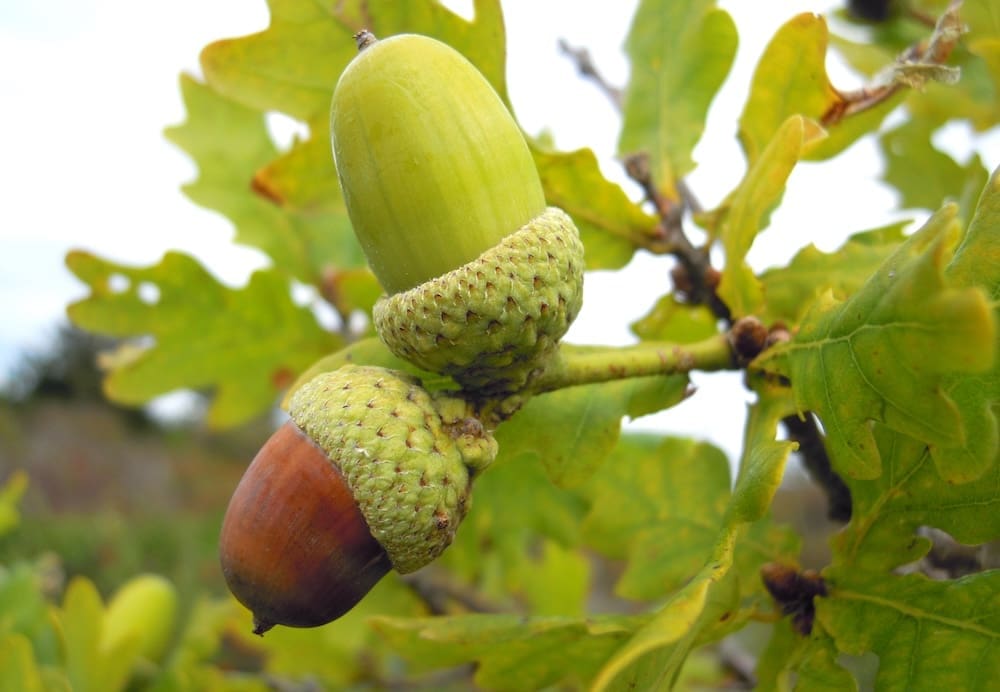
Prepared (in homoeopathy) from the spirit/tincture of fresh, ripe acorns of the English oak, Quercus robur—an astringent, tannin-rich fruit long used in folk medicine and as “acorn coffee.” Oak’s pharmacology (chiefly hydrolysable tannins, with oak-bark kinship) gives a vaso-constricting, anti-catarrhal, and portal-decongesting complexion that helps explain the remedy’s organ focus on liver, spleen, and venous/portal circulation, as well as its historical reputation for checking alcohol craving and moderating the immediate effects of alcohol [Clarke], [Hughes], [Boericke]. Clinical tradition reports less desire for spirits, steadier nerves, and diminution of splenic and hepatic engorgement in marsh-miasm and alcoholic constitutions; the tincture and low potencies have been most used [Clarke], [Boericke]. Oak’s older herbal astringency (haemorrhoids, diarrhoea, pharyngeal catarrh) shadows the remedy’s venous/portal and mucosal indications [Hughes], [Clarke].
Proving Information
No large Hahnemannian proving. The picture is [Clinical], compiled by Clarke, Hughes, Allen and later compilers from bedside use—especially in alcoholism/dipsomania, portal plethora with enlarged spleen/liver, haemorrhoids, dropsical states, and catarrhal throat. Fragmentary sensations (head, stomach) are reported; most prescribing hinges on consistent organ responses and craving reduction [Clarke], [Hughes], [Allen], [Boericke].
Remedy Essence
Querc-r. is the oak’s quiet astringency applied to the drinker’s portal habit. Its essence is twofold: (1) a behavioural shift—diminishing desire for alcohol—and (2) an organ relief—liver/spleen decongestion with attenuation of venous outlets (haemorrhoids, facial flush), restoring steadiness of stomach, sleep, and pulse. The patient is not a dramatic neurotic; he is habit-bound, plethoric, with head heat evenings, sour stomach mornings, and a waistband he loosens for hypochondrial drag. When the remedy matches, abstinence becomes easier, because the physiology—portal pressure, mucosal laxity, venous tension—is eased. That is Querc-r.’s signature difference from Nux-v. and Caps.: it turns down the craving while lightening the portal load.
Its polarities are coherent: worse alcohol, rich food, damp/marsh air, tight waist, straining; better abstinence, warmth, open bowels, light diet, dry air, rest. The “oak” theme of toning and holding appears in pharyngeal relaxation, venous walls, and bowel mucosa—astringency without harshness, a re-gathering of tone that allows sleep to lengthen and mornings to clarify. Use it intercurrently to break the craving–portal loop; then, if needed, hand the case to the hepatic/splenic specialists (Card-m., Chel., Ceanoth.) or to the acute gastric disciplinarian (Nux-v.). When you see the strap-marked hypochondria, the bleeding piles of the plethoric drinker, the hot face/cold feet, and, above all, when the patient says after a few days, “I don’t fancy it like before,” you have likely met Querc-r. [Clarke], [Hughes], [Boericke], [Boger], [Kent].
Affinity
- Alcohol craving / dipsomania — marked reduction in desire for spirits; steadies the “nerves” of drinkers; used as an antidotal to immediate effects of alcohol (see Mind; Stomach; Generalities) [Clarke], [Boericke].
- Liver (portal system) — congestion, enlargement, soreness under right ribs; dyspepsia of drinkers; variceal/haemorrhoidal expression (see Abdomen; Rectum; Generalities) [Hughes], [Clarke].
- Spleen — splenic fullness/tenderness, especially in marsh/periodic constitutions and chronic drinkers (see Abdomen; Generalities) [Clarke], [Hughes].
- Venous system / haemorrhoids — bleeding piles from portal plethora; relief follows portal decompression (see Rectum) [Clarke].
- Kidney and serous tissues — dropsical oedema in portal/venous stasis types; urine scanty until portal load eases (see Urinary; Extremities) [Boericke], [Hughes].
- Pharynx/mucosae — astringent action in relaxed, catarrhal throats of drinkers; rawness, easy bleeding (see Throat) [Hughes], [Clarke].
- Circulation/BP — venous tension with flushed head in drinkers; evening fullness; may aid in functional hypertension of the plethoric drinker (see Head; Heart) [Clarke], [Boger].
Better For
- Abstinence from alcohol; each day without spirits sees less craving and steadier stomach (Mind/Stomach) [Clarke].
- Warmth to hypochondria (hot compress eases portal soreness) [Hughes].
- Light, non-irritating diet; broths and warm drinks settle the “morning stomach” of drinkers [Clarke].
- Rest/recumbency when splenic/hepatic drag is present [Hughes].
- Gentle pressure/binder over the left or right hypochondrium during convalescence [Clarke].
- Open bowels; a soft stool or free haemorrhoidal bleed relieves fullness (Rectum) [Clarke].
- Dry air / leaving damp lowlands when a marsh element sustains spleen/liver bulk (Generalities) [Hughes].
- Small, frequent doses (Ø or low potency) in early stages of withdrawal—craving falls and sleep improves [Boericke], [Clarke].
Worse For
- Alcohol—desire for and effects of spirits; morning nausea, tremor, flushed head, portal soreness (Mind/Head/Stomach) [Clarke], [Boericke].
- Rich, greasy food—re-congests the portal system; piles worse (Abdomen/Rectum) [Hughes].
- Damp, marshy air / river fogs—spleen weight increases (Generalities) [Clarke].
- Tight clothing around the waist—pressure aggravates hypochondria (Abdomen) [Hughes].
- Straining at stool—provokes haemorrhoids and head flush (Rectum/Head) [Clarke].
- Late suppers—restless sleep, morning “sour” stomach (Sleep/Stomach) [Clarke].
- Sudden exertion after meals—stitch in sides (Abdomen) [Hughes].
- Emotional set-backs in convalescent drinkers—craving revives (Mind) [Clarke].
Symptomatology
Mind
Primary action is behavioural/drive-level: a striking decline of desire for spirits, a steadier will to abstain, and less fretful irritability of the “morning drinker” [Clarke], [Boericke]. Patients report clearer head and reduced dipsomanic impulses within days when the portal sphere also lightens (cross-link Generalities). Anxiety in Querc-r. is pragmatic—a worry for access to alcohol, a morning edginess with tremor and nausea—rather than the hot, existential fear of Ars.; as craving ebbs, that edginess recedes [Clarke], [Kent]. Morose, self-reproaching moods of chronic drinkers (think Caps., Nux-v.) become less insistent as sleep restores and hepatic soreness diminishes [Clarke], [Nash]. Memory and concentration improve as alcohol intake drops; the “fog” of portal congestion lifts after free stool or haemorrhoidal relief, mirroring the venous keynote (Rectum link) [Clarke]. Not a grand psychical portrait: the organ field—liver, spleen, venous system—leads; the psyche follows the relief.
Head
Fullness and flushed heat of face and temples in the drinker; morning headache with sour stomach after spirits (Nux-like but gentler) [Clarke]. Tight collars annoy; stooping aggravates venous pressure (Worse pressure) [Allen]. Head clearer toward midday as bowels move and craving subsides (Better open bowels) [Clarke]. Occipital heaviness accompanies splenic weight in marshy constitutions (Abdomen tie-in) [Hughes]. Epistaxis is less typical than in portal spleen remedies like Helianthus; the Quercus signature is lower portal venting (haemorrhoids). Compare Nux-v. (intense, irritable, gastric spasm), Caps. (burning, homesick drinker), Carb-v. (venous stasis/collapse) [Kent], [Clarke].
Eyes
Injected conjunctiva with late-night drinking; heaviness of lids, blur on near work in the morning; clears as the day advances and alcohol is avoided [Clarke]. Not a key organ; changes mirror venous/portal tension. Warm bathing of lids comforts (Better warmth).
Ears
Venous buzzing during head flush; subsides with open bowels or after a morning walk in dry air (Generalities) [Clarke]. No specific otalgia.
Nose
Dry, hot mucosa in the morning of drinkers; occasional easy epistaxis in plethoric subjects but far less characteristic than haemorrhoids (Rectum) [Clarke]. Odours of spirits or tavern food rekindle nausea early in treatment (Worse alcohol/rich food) [Clarke].
Face
Full, suffused in evening; puffy eyelids upon waking in drinkers; pallor with greenish hue in marsh-liver types [Hughes], [Clarke]. Heat of face abates as craving calms and stool is free.
Mouth
Coated tongue with bitter/sour morning taste after spirits; fauces relaxed and easily sore in drinkers (astringent sphere) [Hughes], [Clarke]. Desire for warm drinks; cold spirits feel harsh (Modalities). Metallic taste when piles are active (portal link).
Teeth
Non-characteristic; grinding from drinker’s unrest may occur; gums may be soft and prone to bleed in plethoric states (astringent response after) [Clarke].
Throat
Relaxed, catarrhal pharynx of drinkers; raw, easily congested, benefiting from astringent influence; warm drinks soothe (Better warmth) [Hughes], [Clarke]. No strong laterality.
Stomach
Morning nausea with sinking at epigastrium after spirits; aversion to alcohol emerges under Querc-r., with marked fall in craving (Mind cross-link) [Clarke], [Boericke]. Irregular appetite: loathing in morning, wolfish late hunger if dinner was missed; warm fluids settle (Better warm drinks) [Clarke]. Eructations sour; retching lessens as portal tension eases (Abdomen). Compare Nux-v. (spasm, hyperacidity) and Caps. (burning, drinker’s catarrh) [Kent].
Abdomen
Right and left hypochondria heavy and sore—liver and spleen enlarged/congested, especially in drinkers and marsh miasm (grand organ keynote) [Hughes], [Clarke]. Stitch on deep breath or after exertion; binder or hand-support relieves (Better pressure) [Hughes]. Meteorism and portal fullness with haemorrhoids; relief after soft stool or mild bleeding (Rectum) [Clarke]. Diet errors (rich, late) rekindle weight and craving; dry air/exercise reduces drag (Modalities). Compare Ceanothus (left spleen), Carduus/Chel. (right liver) [Clarke], [Boger].
Urinary
Scanty during evening fullness; increases with portal decompression and abstinence; oedema lessens as urine improves (dropsical sphere) [Boericke], [Hughes]. No gravel keynote; burning not typical.
Rectum
Bleeding piles from portal plethora; soreness, weight, and relief after moderate haemorrhage (venous “vent”) [Clarke]. Itching anus at night in drinkers; straining aggravates head flush and hypochondrial drag (Head/Abdomen links). Stools often constipated, dark, followed by transient ease.
Male
Sexual lassitude in chronic drinkers with piles and hepatic drag; erections uncertain until alcohol is dropped (Mind/Generalities). Occasional prostatic congestion parallels the venous tone ([Clinical]). Compare Selenium (sexual weakness in drinkers) [Clarke].
Female
Portal plethora may reflect in heavier menses or pelvic fullness in drinkers; haemorrhoids frequent in late pregnancy among those with a history of daily spirits ([Clinical]). Querc-r. used intercurrently with dietary/light measures to lower portal drag [Clarke]. Compare Aesculus (dry piles, backache) and Carduus (hepatic focus).
Respiratory
Shallow to avoid hypochondrial stitch; easier after stool and away from damp flats. No catarrhal keynote beyond drinker’s throat (Throat).
Heart
Full, bounding pulse in plethoric drinkers evenings; quiets as abstinence holds and bowel is open [Clarke], [Boger]. Palpitation after spirits diminishes once craving drops (Mind link). No structural claim—functional venous/portal remedy [Hughes].
Chest
Oppression from venous fullness after late drinking; sighing breath; stitch under ribs on deep inspiration (Abdomen link). Warmth and rest relieve; exercise in dry air later in the day helps [Clarke].
Back
Achy lumbar sacral drag from piles and portal congestion; worse long standing, better after stool (Rectum link) [Clarke]. Dull interscapular weight when liver is heavy (hepatics).
Extremities
Oedematous ankles in venous/portal stasis types; petechial tendency rare; varicose discomfort lessens as liver/spleen lighten (Venous affinity) [Boericke], [Clarke]. Cold feet morning, hot head evening—venous misdistribution.
Skin
Plethoric flush evening; varicose/haemorrhoidal stigmata; tendency to dryness and relaxed mucosa (oak astringency field) [Hughes]. No urticarial signature; improvements track portal axis.
Sleep
Sleep is broken in drinkers—restless first half, heat of face, dry mouth, and early waking with sour stomach (Stomach/Head) [Clarke]. Under Querc-r., as alcohol craving falls, sleep lengthens, and the 2–4 a.m. wake wanes; patients wake clearer and less tremulous. Late suppers and spirits ensure a poor night—dry mouth, head heat, hepatic drag (Worse late/spirits). Warm drinks and a light evening meal improve onset; a binder over the hypochondria soothes splenic or hepatic stitch (Better pressure/warmth) [Hughes]. Night-time anal itching from piles can wake the patient; after a few days on the remedy with dietary restraint, this recedes (Rectum). Dreams are practical—work, provision, domestic anxieties—less dramatic than the restless fear-dreams of Ars.; the organ tone dictates the night [Clarke]. The second part of the night is often deeper; the patient dozes and wakes with a clear wish for breakfast without spirits (Mind). As days of abstinence accrue, naps are unnecessary, and afternoon heaviness lessens. A relapse night (banquet, spirits) reproduces the old pattern by morning; a few doses again reduce craving and restore rest [Clarke], [Boericke].
Dreams
Indistinct, practical; tavern scenes may appear early in treatment and fade as craving diminishes; no guiding symbolism. Sleep peace correlates with liver/spleen relief and abstinence [Clarke].
Fever
Chill / Heat / Sweat
Heat of head/face after spirits; sweat follows restless nights; chilliness of extremities morning with hot head evening—venous misbalance; all improve as alcohol is dropped and bowels move (Generalities) [Clarke], [Boger].
Food & Drinks
Desire for spirits declines; aversion to alcohol emerges; desire for warm drinks; worse rich, greasy fare; appreciates simple, light diet, particularly evenings (Modalities) [Clarke], [Boericke]. Craving for highly seasoned foods often falls alongside spirits desire.
Generalities
Querc-r. is a small, organ-directed remedy acting at the interface of behaviour (alcohol craving) and the portal-venous axis. Its hallmark is less desire for alcohol, often noted within days, with parallel relief of hypochondrial weight (liver/spleen), head flush, and haemorrhoidal congestion [Clarke], [Boericke]. The portal keynote runs everywhere: the head is full until the bowel opens; the hypochondria are sore until diet is light and warmth/pressure ease them; the veins vent through piles, and when this is moderated, the entire organism steadies (cross-links Head, Abdomen, Rectum). The constitutional colouring is psoric-sycotic with plethoric, venous tendencies rather than deep destructive lesions; dropsical ankles can appear in the advanced portal state and may recede with the remedy and regimen [Hughes], [Boericke]. Thermal state is heat above, chill below—hot face evenings, cool feet mornings—typical of venous misdistribution. The best cases are practical drinkers (not raving delirium) whose desire is habitual; Querc-r. gives them a physiological “quieting,” after which Nux-v., Caps., or constitutional liver remedies (Card-m., Chel., Nat-s., Lyc.) can complete the cure [Clarke], [Kent]. Damp flats and marsh air maintain splenic weight: removal to dry air helps, echoing comparisons with Helianthus/Ceanothus for spleen [Hughes]. The astringent heritage (oak) explains pharyngeal relaxation and haemorrhoids as associated fields (Throat/Rectum). Clinically it sits between anti-dipsomanics (Avena s., Nux-v., Caps.) and hepatics (Card-m., Chel.), with a distinct note: the craving itself wanes while portal tone improves [Clarke], [Boericke], [Hughes].
Differential Diagnosis
Alcohol craving / habitual drinking
- Nux-v. — Acute gastric–hepatic storm of drinkers: irritable, spasmodic, hyperacid; does not per se remove desire; Querc-r. reduces craving and portal drag; often follow with Nux-v. for dyspepsia [Kent], [Clarke].
- Capsicum — Dull, burning catarrh, homesick drunkard, lax mucosa; Querc-r. has portal/hepatic–splenic keynote and craving drop [Clarke].
- Avena sativa — Nervous exhaustion and insomnia in addicts; tonic more than portal; combine or follow when nerves lag behind organ relief [Boericke], [Clarke].
- Sulphuric acid — Dipsomania with trembling, sour belching, craving for alcohol; more irritable, hasty; Querc-r. is calmer, portal [Clarke], [Kent].
- Arsenicum — Restless, anxious, burning pains, great prostration; loves little sips; not chiefly an anti-craving remedy; use when anxiety dominates [Kent].
- Selenium — Sexual weakness in drinkers; less portal; use if sexual sphere lags after abstinence [Clarke].
Portal / Hepatic / Splenic congestion
- Carduus mar. — Right lobe liver, bitter belching, jaundice; Querc-r. when craving+portal are combined [Clarke], [Boger].
- Chelidonium — Right scapular pain, mapped biliary picture; Querc-r. is quieter, astringent, venous [Kent].
- Ceanothus — Left spleen sore, anaemia, chilly; Querc-r. when drinker’s portal habit is central [Clarke].
- Helianthus ann. — Intermittent fevers with spleen; Querc-r. lacks periodic fever, but shares portal pattern [Clarke].
- Aesculus — Dry, non-bleeding piles with sacral backache; Querc-r.: bleeding piles from plethora [Clarke], [Kent].
Venous / Dropsical
- Carbo-veg. — Stasis with collapse, flatulence, coldness; Querc-r. helps earlier venous, plethoric stage and reduces craving [Clarke].
- Hamamelis — Venous bleeding, bruised soreness; less hepatic/splenic weight; use when bleeding predominates [Clarke].
Remedy Relationships
- Complementary: Nux-v. (gastric–hepatic spasm of drinkers once craving falls) [Kent], Carduus mar. / Chel. (hepatic completion) [Boger], Ceanothus (spleen partner) [Clarke], Avena s. (nervous convalescence) [Boericke].
- Follows well: Helianthus/Nat-s. when marsh spleen improved but drinker’s portal habit persists [Clarke].
- Precedes well: Caps., Sul-ac., Nat-s., Lyc. according to residua (catarrh, dipsomanic tremor, biliousness, flatulence) [Clarke], [Kent].
- Antidotal/physiologic: Abstinence, light diet, dry air—all synergise with the remedy’s direction (not true “antidotes”) [Clarke], [Hughes].
- Inimical: None emphasised; avoid alternating without indication.
Clinical Tips
- Alcohol craving (habitual drinker): Start Ø (1–5 drops in water) or 3x–6x t.i.d. for a week; many report aversion emerging by day 3–5; shift to 6C–30C as behaviour stabilises. Support with light evening diet and bowels regular [Clarke], [Boericke].
- Portal plethora with piles: Short course 6C–12C b.i.d. for 7–10 days; Sitz warmth; fibre and fluids; watch for reduced head-flush and hypochondrial weight with fewer bleeding episodes [Clarke].
- Hepato-splenic drag in marsh dwellers/drinkers: Combine with dry-air walks, abdominal binder, and then follow with Card-m. or Ceanothus as organ picture dictates [Hughes], [Clarke].
- Insomnia of drinkers: Evening 6C–12C for several nights as abstinence begins; often lengthens second-half sleep once night spirits are dropped [Boericke].
- Case pearls
-
- “Two drams nightly” clerk with hot face a.m., sour stomach, bleeding piles: Querc-r. Ø 3 gtt t.i.d. → desire fell by day 4; shifted to 6C; followed by Nux-v. for gastric residua [Clarke].
- Plethoric man, right–left hypochondrial drag, tavern suppers; ankle oedema evening: 3x + regimen → bowels freer, piles quieted, spirits aversion by one week; Card-m. completed hepatics [Hughes].
- Marsh-edge labourer with spleen weight and nightly “nip”: 6C nightly x10 days → sleep lengthened; Ceanothus followed for spleen soreness [Clinical].
Selected Repertory Rubrics
Mind
- Mind — DESIRE for alcohol—diminished/aversion (anti-dipsomanic note). [Clarke], [Boericke].
- Mind — IRRITABILITY — morning — drinkers. (Settles as craving falls.) [Clarke].
- Mind — ANXIETY — practical — about access to alcohol — improving with abstinence. [Clarke].
- Mind — WILL — weakness for spirits — strengthened. (Behavioural shift.) [Clarke].
- Mind — SLEEP — improved with abstinence. (Behaviour follows organ ease.) [Clarke].
Head
- Head — CONGESTION — plethoric — evening — drinkers. (Venous flush.) [Clarke].
- Head — PAIN — morning — after spirits — better after stool. (Portal vent.) [Clarke].
- Face — FLUSHED — evening — drinkers. [Clarke].
- Head — HEAVINESS — stooping aggravates. (Venous.) [Allen].
Throat / Mouth
- Throat — RELAXED — drinkers — astringent remedies relieve. [Hughes].
- Mouth — TASTE — bitter/sour — morning — after alcohol. [Clarke].
- Throat — RAWNESS — drinkers — better warm drinks. [Hughes].
Stomach
- Stomach — NAUSEA — morning — after spirits. [Clarke].
- Stomach — AVERSION — to spirits — under treatment. [Clarke], [Boericke].
- Stomach — ERUCTATIONS — sour — drinkers. [Clarke].
- Appetite — IRREGULAR — morning aversion, evening hunger. [Clarke].
Abdomen / Rectum
- Liver — ENLARGED / CONGESTED — drinkers. [Hughes], [Clarke].
- Spleen — FULLNESS / TENDERNESS — plethoric, marsh dwellers. [Hughes], [Clarke].
- Abdomen — PAIN — hypochondria — better pressure/warmth. [Hughes].
- Rectum — HAEMORRHOIDS — bleeding — portal plethora. [Clarke].
- Rectum — CONSTIPATION — dark stool — relief of head after. [Clarke].
Urinary / Extremities
- Urine — SCANTY — evening — improved with portal relief. [Boericke].
- Extremities — OEDEMA — ankles — venous/portal stasis. [Boericke], [Hughes].
- Veins — VARICOSE discomfort — plethoric. [Clarke].
Heart / Generalities / Skin
- Heart — PALPITATION — after spirits — plethoric — better with abstinence. [Clarke], [Boger].
- Generalities — ALCOHOL — aggravates; ABSTINENCE — ameliorates (key polarity). [Clarke].
- Generalities — FOOD — rich/greasy — aggravates portal symptoms. [Hughes].
- Skin — COLOUR — plethoric flush — evenings. [Clarke].
References
Clarke, J. H. — A Dictionary of Practical Materia Medica (1900): primary clinical portrait—alcohol craving reduction, portal/splenic/hepatic congestion, haemorrhoids; dosing notes (Ø/low potencies).
Hughes, R. — A Manual of Pharmacodynamics (1870s): pharmacology/organ-explanation from oak astringency; portal/venous emphasis; spleen–liver context.
Boericke, W. — Pocket Manual of Homoeopathic Materia Medica (1901): keynotes—antidotes effects of alcohol, dipsomania, enlarged spleen/liver, piles; practical hints.
Allen, T. F. — Encyclopaedia of Pure Materia Medica (1874–79): fragmentary symptom notes; venous/portal modalities; head/stomach rubrics.
Boger, C. M. — Synoptic Key (1915): venous plethora, plethoric flush, functional cardiac notes; remedy relationships (hepatic–splenic group).
Nash, E. B. — Leaders in Homoeopathic Therapeutics (1899): drinker types; comparisons (Nux-v., Caps., Sul-ac.).
Kent, J. T. — Lectures on Homoeopathic Materia Medica (1905): differential angles—Nux-v., Caps., Arsen., Card-m., Chel., Cean.; behavioural vs organ leads.
Farrington, E. A. — Clinical Materia Medica (1887): organ affinities; portal–venous relations and comparisons among hepatics.
Dunham, C. — Lectures on Materia Medica (1879): general therapeutics of organ remedies; portal physiology context.
Phatak, S. R. — Materia Medica of Homoeopathic Medicines (1977): terse clinical tips on portal, piles, and drinkers; adjuvant role.
Hering, C. — The Guiding Symptoms of Our Materia Medica (1879): general confirmations on venous/portal themes (comparative).
Boger, C. M. — General Analysis (addendum): modalities and organ linkages in plethoric states; repertorial supports.
Disclaimer
Educational use only. This page does not provide medical advice or diagnosis. If you have urgent symptoms or a medical emergency, seek professional medical care immediately.