

Anhalonium lewinii
Substance Background
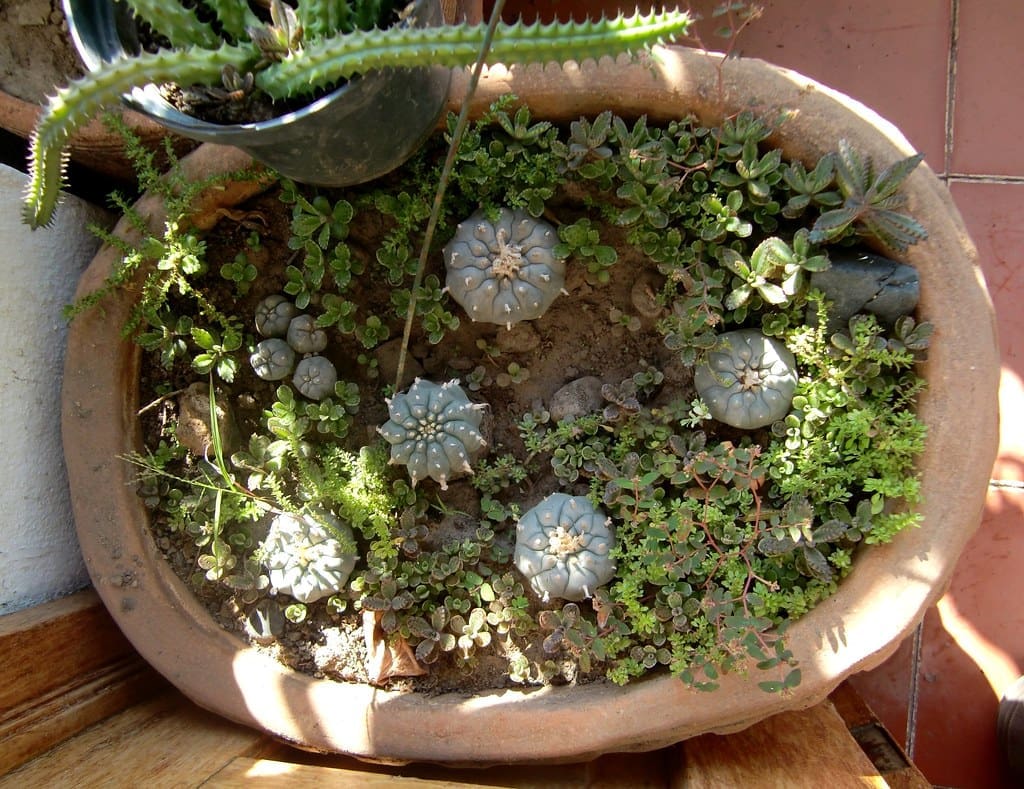
Anhalonium lewinii (now botanically Lophophora williamsii) is a small, spineless cactus of the family Cactaceae native to arid regions of northern Mexico and the southern United States. The dried “buttons” (crown discs) contain indole alkaloids—most notably mescaline—together with pellotine and related bases. In toxicology and experimental literature, the plant evokes brilliant kaleidoscopic visual phenomena, altered time-space sense, disembodied or “dual” consciousness, synaesthesia, and relative analgesia, alongside mydriasis and autonomic shifts. Homeopathic tincture is made from the fresh cactus and potentised; classical accounts emphasise mind and sensorium, with a lesser action on sleep, the eyes, and the heart/circulation [Clarke], [Boericke], [Hale], [Boger].
Proving Information
The picture rests chiefly on provings, self-experiments, and toxicologic observations published by Hale and others, later synthesised by Clarke and Boericke. Recurrent [Proving] / [Toxicology] features include: gorgeous visual spectra and geometric forms, synaesthesia (colours “heard,” sounds “seen”), exalted self-awareness or dissolution of personality, errors of time and distance, levitation/float sensations, tranquil euphoria with indifference to pain, insomnia from racing imagery, dilated pupils and visual halos, and palpitation or irregular pulse in sensitive subjects [Hale], [Clarke], [Boericke], [Boger], [Allen].
Remedy Essence
Anhalonium is the quiet vision-maker. The self loosens its borders; time unhooks, space dilates, and colour-symphonies unfold behind the eyes. Unlike the fevered theatres of Bell. or the terror-corridors of Stram., the affect is calm, contemplative, even devout. The patient lies awake for hours, not distressed but enchanted, and by dawn is unrested yet strangely unruffled. Synaesthesia bridges senses—music colours the darkness; light hums—and the body’s pains recede to a curious neutrality. Practical life, however, stumbles: exactness fails, distances deceive, letters dance, and tasks drag because time stretches. The heart becomes an object of attention (palpitation), not of fear; breath a counted metronome. Modal keywords knit this portrait: worse glare, noise, contradiction, and night when trying to sleep; better dimness, quiet, gentle music, solitude, and repose. When you meet insomnia with kaleidoscopic inner imagery; serene derealisation; synaesthesia; analgesic detachment; and misjudged time–space, Anhalonium speaks with unusual purity [Clarke], [Boericke], [Hale], [Boger].
Affinity
- Cerebral cortex & sensorium. Alters apperception: time dilates or stops; space vast or near; self feels double or dissolved—central keynotes. See Mind/Generalities. [Clarke], [Hale], [Boericke].
- Special senses (especially vision). Kaleidoscopic colours, star-bursts, mandala-like forms, intensified light, coloured halos; mydriasis. See Eyes. [Clarke], [Boericke].
- Sleep centres. Insomnia with persistent inner imagery; dreamy dozing without rest. See Sleep. [Boericke], [Hale].
- Autonomic / heart. Palpitation, irregularity, anxious heart-awareness; secondary to sensorium changes. See Heart/Chest. [Clarke], [Boger].
- Pain-perception. Relative analgesia or indifference to pain; serenity despite complaints. See Generalities/Mind. [Hale], [Clarke].
- Psycho-sensory integration. Synaesthesia: sounds perceived as colours, forms “sing”; hyperesthesias with paradoxical calm. See Mind/Eyes/Ears. [Clarke], [Boericke].
Better For
- Quiet, dim light, eyes closed—visions are beautiful and non-threatening; anxiety subsides. See Mind/Eyes. [Clarke].
- Music (soft)—harmonises imagery; synaesthesia becomes pleasant rather than disorienting. See Ears/Mind. [Hale], [Clarke].
- Aloneness and repose, contemplation; gentle reclining with eyes covered. See Mind/Sleep. [Boericke].
- Warmth and steady ambience; avoidance of startling stimuli. See Generalities. [Clarke].
- Steady, slow breathing; simple grounding reduces palpitation. See Heart/Respiration. [Boger].
Worse For
- Bright light, glare, colours in motion—visions intensify to confusion. See Eyes. [Clarke], [Boericke].
- Noise, sudden touch, contradictions—startle amplifies percept distortion. See Mind. [Hale], [Clarke].
- Night, when trying to sleep—inner panorama prevents sleep. See Sleep. [Boericke].
- Longevity of effects after slight dose—long after-sensations; exhaustion after vigil. See Generalities. [Hale].
- Attempting exact tasks (reading fine print, measuring distance)—misjudgment provokes anxiety. See Mind/Eyes. [Clarke].
Symptomatology
Mind
A leading sphere. Consciousness is expanded, split, or displaced: the patient may watch himself from outside, “two selves”, or feel ego-dissolution with serene impersonality—“nothing matters”—yet without the terror of Stram.; rather a tranquil wonder often prevails [Clarke], [Hale]. Time appears endless or arrested; minutes stretch to hours; space seems boundless or distorted (near seems far, small vast), causing missteps or misreaches [Clarke], [Boericke]. Synaesthesia: sounds paint colours; forms hum; aromas have “hues”—a signature crossover [Hale]. Imagination luxuriant, visions in splendid colours, mandala-like geometries, processional images, sometimes with religio-mystic exaltation; yet the will is quiet, not frantic as in Bell. [Clarke], [Boericke]. Indifference to pain and to bodily states appears; the sufferer may observe his discomfort as if another’s [Hale]. Anxiety, when present, arises from loss of orientation or heart-awareness; it is better by quiet, dimness, and reassurance [Clarke]. Memory for practical sequences is poor during the state; speech may become slow, rapt, or overly aesthetic; task-execution falters owing to time/space error [Clarke], [Boger]. Case note (Proving): “Felt lifted from body, gazed at self in bed; colours wheeled behind eyelids; no wish to sleep” [Hale].
Head
Lightness as if head were hollow or floating; sometimes tight band-likeness with shimmering aura before eyes [Clarke]. Vertex expansion or skull feels open to the sky; turning the head misjudges distance, causing a sway [Boericke]. Dull aching after long vision-trance, better quiet and dark. Motion can provoke sea-like undulation in the brain; nausea is uncommon but may come from visual overload more than gastric disturbance (cf. Tab.) [Clarke].
Eyes
Pupils dilated; light dazzles. With lids closed: intense kaleidoscopic colour-forms, star-bursts, spirals, mosaics; with lids open: haloed lights, coloured fringes, faces idealised or distorted (exaltation or grotesquerie) [Clarke], [Boericke]. Distance and size misjudged: the near recedes, the small enlarges. After-images persistent; phosphenes on pressure. Reading fails from dancing letters; better shaded room, worse glare [Clarke].
Ears
Music exquisitely vivid; tones appear coloured; echoes prolonged; ordinary noise jars and “splinters the colours” (patient’s metaphor) [Hale], [Clarke]. Tinnitus like silver bells or humming; hearing otherwise acute yet fatigued by disharmony.
Nose
Not a primary seat. Occasional phantosmia—scents perceived as hues (synaesthesia); nasal mucosa otherwise quiet. If coryza or rawness dominates, select another remedy [Clarke].
Face
Quiet, rapt expression; pallor during intense inner panorama; flush with sudden emotion. Features may appear to the patient idealised (beautified) or mask-like in others—perceptual, not structural [Clarke].
Mouth
Dryness moderate; taste altered to a subtle sweetness during ecstasy; thirst small despite wakeful nights (contrast Coff.) [Boericke]. Tongue may feel larger (kinaesthetic distortion).
Teeth
No distinct odontalgic keynote; relative analgesia may mask minor dental pains during episodes [Hale].
Throat
Sense of wideness or unimpeded column in pharynx; swallowing automatic; little true soreness. Talking can feel effortful because time to form words seems long [Clarke].
Stomach
Abdomen
Unremarkable. Subtle abdominal “emptiness” during dissociation may be noted; bowels tardy after sleepless nights; nothing characteristic.
Urinary
Slight polyuria after long vigil; otherwise negative.
Rectum
No keynote beyond quiet bowel; if rectal symptoms predominate, search elsewhere.
Male
Libido variably exalted or indifferent; sensations aesthetic rather than urgent. Erections weak during vigil; not a sexual remedy per se [Clarke].
Female
States of mystic exaltation round menses have been noted, with insomnia and colour-visions; not a core gynaecic remedy.
Respiratory
Calm, slow; may become consciously regulated (patient watches his breathing clock). Dyspnoea is uncommon and psychogenic when present; reassure and darken room [Clarke].
Heart
Palpitation or irregularity from emotional or perceptual surge; the awareness of heart-beat may be magnified subjectively (time dilation); objective disturbance slight. Better quiet, recumbency, and slow breathing [Clarke], [Boger].
Chest
Chest feels wide; breath deep yet effortless; sighing in contemplation [Clarke]. Dryness or tickle minimal.
Back
Lightness along spine; levitation sensations as if the dorsal region rose from the couch; no structural pain.
Extremities
Limbs light, floating; movements mis-timed; reaches miss by inches (space-error). Analgesia or indifference to minor bruises; gait may be slow, ceremonial [Hale], [Clarke].
Skin
Touch exquisitely pleasant or neutral; pain-threshold raised. Colours seen “within” the skin with eyes shut—subjective phosphenes. Sweating slight, not relieving insomnia [Clarke].
Sleep
A chief sphere. Sleepless because inner visions stream on; the patient lies tranquil, not restless, watching colours and processions; time ceases; on dozing, dreams continue the pageant; waking is unrefreshed though not miserable [Boericke], [Clarke]. Attempts to sleep worse in bright rooms; better in dark, quiet, cool ambience. Startle on crossing into sleep with sensation of falling then floating. After long vigil, daytime drowsiness without ability to nap (images return on closing eyes).
Dreams
Brilliant, symbolic, geometric, ritual; sacred or ceremonial motifs; flying, floating, vast spaces, temples of light; often pleasant and observed rather than suffered; occasional anxiety when distance-time distort beyond control [Clarke], [Hale].
Fever
No febrile pattern proper. Heat or flush during vision-trance; chill if suddenly exposed to glare or noise; sweat slight.
Chill / Heat / Sweat
Chill: from shock of light/noise. Heat: head/face during exaltation. Sweat: minimal, not relieving sensorium.
Food & Drinks
Little craving; alcohol, coffee may over-stimulate and confuse images (practical caution). Prefers cool water in sips.
Generalities
The essence is altered apperception: brilliant inner colour-forms; time and space dislocated; ego loosened or doubled; serenity with analgesia. The state is quiet, contemplative, aesthetic—not the noisy terror of Stram. nor the irritable drive of Nux. Modalities are coherent: worse light, noise, effort, night (when trying to sleep); better dark, quiet, music (harmonious), repose. Indications arise in insomnia with racing inner imagery; post-shock derealisation; states of detached calm with poor tasking; heart-awareness with time dilation. Compare Cannabis-ind. (expansion of ideas/time, but more talkative/humorous), Bell. (florid delirium with heat and violence), Stram. (night-terror, terror of darkness), Op. (profound insensibility with retained images), Nux-m. (drowsy dissociation with dryness), Agar. (fantastic visions with clumsiness, more spinal twitch) [Clarke], [Boericke], [Boger], [Hale].
Differential Diagnosis
Expansion / Time–Space distortion
- Cannabis indica — Exalted ideas, laughter, music ravishment; more talkative and whimsical; Anh. is quieter, contemplative, colour-kaleidoscopic [Clarke], [Boericke].
- Nux moschata — Drowsy, dreamy, dry, memory blank; less colour-pageant; more sopor/forgetfulness [Boger], [Boericke].
- Opium — Grandiose visions with insensibility; heavy stupor; Anh. maintains clarity and aesthetics [Clarke].
Night terrors / ecstatic vs. fearful
- Stramonium — Terror, violence, hallucinations frightful; hates dark; Anh. welcomes dimness, serenity predominates [Clarke].
- Belladonna — Hot, throbbing, furious delirium; images vivid but pyrexial and aggressive; Anh. is afebrile, tranquil [Boericke].
- Hyoscyamus — Lewd, silly, jealous; hallucinations coarse; Anh. is artistic, mystical [Clarke].
Synaesthesia / aesthetic exaltation
- Agaricus — Fantastic dancing images with twitching, clownishness; Anh. is stately, mandala-like [Boger].
- Platina — Magnified self, aesthetic hauteur; less sensory crossover; more pride than poise [Clarke].
- Coffea — Hyperaesthesia, sleepless from ideas; but coffee aggravates; Anh. seeks quiet rather than mental jubilee [Boericke].
Analgesia / indifference to pain
- Opium — Painlessness with stupor; Anh. painless yet lucid [Clarke].
- Coca — Indifference with stimulation; motor over-activity; Anh. is inward, still [Boger].
Cardio-neurotic awareness
Remedy Relationships
- Complementary: Cannabis-ind. (creative mind states; when talkative hilarity overlays Anh. serenity, Cannabis may complete the case) [Clarke].
- Complementary: Agaricus (when visual fantasia coexists with motor twitch/clumsiness) [Boger].
- Follows well: Acon. or Ign. after shock when derealisation persists as colour-visions with insomnia [Clarke], [Boericke].
- Precedes well: Coffea in purely ideational insomnia once the colour-pageant has subsided; or Nux-m. when the case collapses into drowsy dreaminess with dryness [Boericke], [Boger].
- Antidotes (clinical): Nux-v., Camph., quiet dark room, reassurance—when over-stimulated or anxious from perceptual overload [Clarke], [Boericke].
- Inimicals: None clearly recorded.
Clinical Tips
- Use-cases. Sleepless visions at night with serene detachment; post-shock derealisation with aesthetic inner scenes; creative over-aesthetic states impairing function; heart-awareness with time dilation but without frank panic [Clarke], [Hale], [Boericke].
- Potency & repetition. For functional insomnia and sensorium states: 30C once–twice daily for several days, then pause and watch. In entrenched perceptual syndromes: 200C single dose at night; repeat by clear relapse. Low potencies (6C/12C) if sensitivity high, with strict environmental supports (dark, quiet). Always reduce frequency as improvement holds [Boericke], [Boger].
- Adjuncts. Dark room, minimal screens, soft music if it soothes (otherwise silence), breathing cadence (4–6/min), warm non-stimulating drinks. Avoid late coffee/alcohol (tend to scatter imagery) [Clarke], [Boericke].
- Pearls.
Selected Repertory Rubrics
Mind
- Dual consciousness; feels outside the body observing self. Keynote of Anh. [Clarke], [Hale].
- Delusions of time and space; minutes seem hours; distances misjudged. [Clarke], [Boericke].
- Exaltation; mystical serenity; indifference to pain. [Hale], [Clarke].
- Synaesthesia: hears colours / sees sounds. [Clarke], [Hale].
- Desire for solitude; aversion to interruption. [Boericke].
Head
- Head feels light, hollow, floating; vertex expansion. Better dark, quiet. [Clarke], [Boericke].
- Brain-waves as if undulating; motion aggravates visual nausea. [Clarke].
Eyes
- Mydriasis; light dazzles; coloured halos. [Boericke], [Clarke].
- Closed-eye kaleidoscopic visions (mandalas, star-bursts). [Clarke].
- Objects change size/distance (micropsia/macropsia). [Clarke].
Ears
- Music ravishing, appears coloured; echoes prolonged. [Hale], [Clarke].
- Noise intolerable; startles and scatters images. [Clarke].
Sleep
- Sleepless from inner visions; lies tranquil, watching colours. [Boericke], [Clarke].
- Dreams brilliant, symbolic; flying, temples, vast spaces. [Clarke], [Hale].
Heart / Generalities
- Palpitation with heightened awareness; anxiety better quiet/dark. [Clarke], [Boger].
- Analgesia / indifference to pain during exalted state. [Hale].
- Worse light, noise, night (on trying to sleep); better quiet, darkness, music. [Boericke], [Clarke].
References
Hale — New Remedies (var. eds., late 19th c.): provings/self-experiments; colour-visions, synaesthesia, analgesia; insomnia.
Clarke — A Dictionary of Practical Materia Medica (1900): full synthetic portrait—time/space distortion, dual consciousness, heart-awareness, modalities.
Boericke — Pocket Manual of Homoeopathic Materia Medica (1901): keynotes—kaleidoscopic visions, serenity, insomnia, mydriasis; differentials.
Boger — Synoptic Key of the Materia Medica (1915): generalities and relationships; heart-awareness; better quiet/dark.
Allen, T. F. — Encyclopaedia of Pure Materia Medica (1874–79): comparative notes on allied mental states (contextual placement).
Hughes — A Manual of Pharmacodynamics (1893): pharmacologic context for mescaline-like effects; sensorium rationale.
Farrington — Clinical Materia Medica (1887): differentials among delirious–visionary remedies (Bell., Stram., Op., Cann-ind.).
Kent — Lectures on Homoeopathic Materia Medica (1905): comparative philosophical remarks—Cann-ind., Op., Stram. in hallucinosis (context).
Nash — Leaders in Homoeopathic Therapeutics (1898): leaders for insomnia and mental states (comparative).
Tyler — Homoeopathic Drug Pictures (1942): comparative insights on visionary remedies and practical hints (context).
Hering — The Guiding Symptoms of Our Materia Medica (1879–): corroborative symptom analogies (sensorium and sleep).
Dewey — Practical Homoeopathic Therapeutics (1901): therapeutics of insomnia and neuro-functional states; placements and comparisons.
Disclaimer
Educational use only. This page does not provide medical advice or diagnosis. If you have urgent symptoms or a medical emergency, seek professional medical care immediately.