

Prunus spinosa
Substance Background
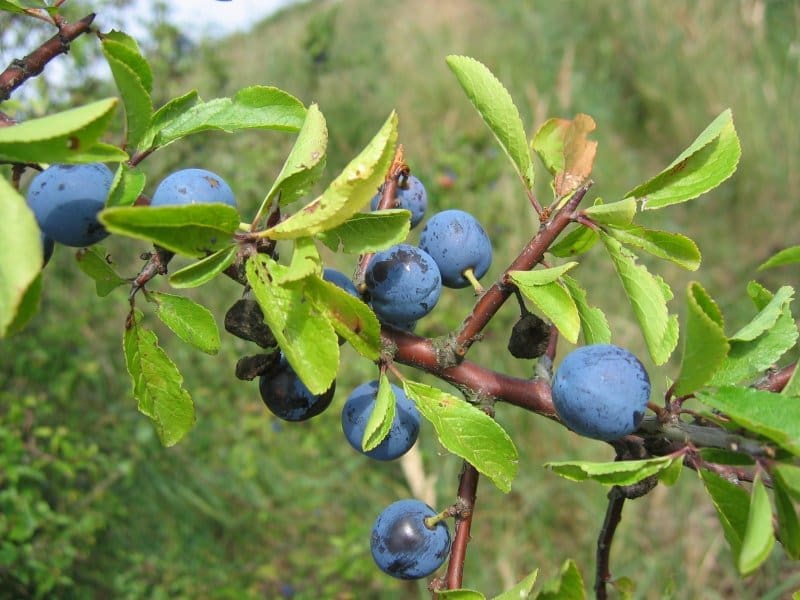
A spiny, deciduous shrub of the Rosaceae bearing astringent blue-black sloes rich in tannins, organic acids, and flavonoids. In homoeopathy a tincture is prepared from the fresh bark of young twigs (sometimes root-bark/flowers) at the onset of flowering; its marked astringency and peripheral neurovascular activity help explain the remedy’s sudden, constrictive, neuralgic pains and its action on ciliary nerves, trigeminal branches, urinary tract sphincters, and cardiac/chest walls [Clarke], [Hughes]. [Toxicology]
Proving Information
Recorded chiefly by the German school and collated by Allen and Hering; clinical confirmations accrued for explosive neuralgias (especially ciliary/trigeminal), sudden stabbing cardiac and intercostal pains, and spastic dysuria/retention with pain at the root of the penis [Allen], [Hering], [Clarke], [Boericke]. [Proving] [Clinical]
Remedy Essence
Prunus spinosa is a nerve-edge remedy: the pains are sudden, electric, stabbing, or bursting, compelling absolute stillness. The picture is drawn along exposed peripheral nerve tracts—ciliary, trigeminal, intercostal/cardiac, coccygeal, and urethral—where cold wind, draught, movement, or touch launches a paroxysm. The eye keynote is unmistakable: the patient presses the lid and keeps perfectly still in a dark room, whispering that the eye will be “pushed out” if they move; here Spigelia is the nearest neighbour, but where Spigelia bores and throbs (often left), Prunus shoots and bursts (often right) [Hering], [Clarke]. Across the face, the zygomatic track lights like a wire; shaving, washing, or wind on the cheek fires pain “like a knife.” In the urinary sphere, root-of-penis pain with sudden stoppage is decisive; the neck of the bladder spasms, urging is fruitless, then a few drops cut like glass until the spasm lets go—after which the mind, like the sphincter, relaxes [Clarke], [Boericke]. The chest/heart gives neuralgic stitches—shot-like, left-sided, darting to scapula—less a vascular crush (Cactus) than a nerve-shock that abates with quiet, steady breaths [Boger], [Farrington]. Zoster—especially ophthalmic—is another field: post-herpetic electric darts in a hypersensitive skin map respond when modalities match (worse draught/motion/touch; better warmth, pressure, dark, rest). The prescriber should listen for verbs: shoots, stabs, bursts, stops suddenly—and for the behaviour: the patient freezes; they cover, press, darken the room, and hardly dare to breathe. Where those words and that posture appear, Prunus spinosa often unlocks the case. [Hering], [Clarke], [Boericke], [Boger]
Affinity
- Ciliary nerves / eyes: Sudden, bursting pains “as if the eyeball would be forced out”, ciliary neuralgia after exposure, chill, or ocular strain/operation; photophobia with tearing. See Eyes. [Hering], [Clarke], [Boericke]
- Trigeminal branches (supra/infraorbital, zygomatic): Electric, shooting, or knife-like facial pains, often right-sided, darting to ear/occiput. See Face, Head. [Allen], [Boger]
- Urinary tract sphincters / neck of bladder / prostate: Pain at the root of the penis with urging; urine stops suddenly or is retained from spasm; cutting and burning in urethra. See Urinary, Male. [Clarke], [Boericke]
- Intercostal / cardiac nerves: Stitches, clamps, bands, sudden left-sided chest pains darting to scapula/arm; neuralgic angina-like sensations in sensitive patients. See Chest, Heart. [Boger], [Farrington]
- Peripheral sensory nerves / herpes zoster: Post-herpetic and zoster-ophthalmicus pains with exquisite tenderness; pains shoot like lightning. See Skin, Eyes. [Hering], [Clarke]
- Coccygeal/sacro-iliac region: Sharp, stabbing coccygeal pains on sitting or after strain. See Back. [Boericke]
- Hands/feet digital nerves: Stitching pains in fingers/toes; nails feel tender. See Extremities. [Allen]
- Right side predominance (face/eye) but can alternate sides in outbreaks of neuralgia. See Face, Eyes. [Boger], [Clarke]
Better For
- Rest, keeping very still—movement re-ignites the “electric” pains (echoed under Face, Eyes, Chest) [Boger].
- Gentle pressure or bandaging around the painful part (eye/chest), briefly lessens bursting sensations [Clarke].
- Warmth to face/eyes and warm room after chill exposure [Hering].
- Darkness/closing eyes; avoiding visual exertion (reading) [Clarke].
- After a free passage of urine when spasm relaxes (urinary pains ease) [Boericke].
- Lying quietly on the sound side (neuralgias less jarring) [Clinical].
- Slow, steady breathing during chest stitches (reduces splinting spasm) [Farrington].
- Local soothing applications during zoster (supportive; pain lessens) [Hering].
Worse For
- Sudden motion, stepping hard, turning the head/eyes; jarring [Boger].
- Cold wind, chill, draughts, especially to the face/eyes (triggers ciliary/trigeminal pain) [Hering], [Clarke].
- Strain of vision (reading, embroidery, glare) → bursting eye pains [Clarke].
- Night, particularly toward midnight; pains wake with a start [Allen].
- Touch of the affected nerve track; even brushing hair or washing face may shoot pain [Hering].
- Suppressed/retarded urine; urging without flow re-excites root-of-penis pain [Boericke].
- Stooping or lifting (coccygeal/intercostal stabs) [Boger].
- Emotional tension/startle, after vexation; pains leap like shocks [Farrington].
- Right side of face/eye notably (though not exclusively) [Clarke], [Boger].
Symptomatology
Mind
Neuralgic crises colour the mood: a strained, tense anxiety with fear to move lest the lightning-like pain spring again [Hering]. Irritability and oversensitivity accompany face and eye attacks; patients avoid conversation and light, preferring quiet and dark—this tallies with the rest/darkness ameliorations under Modalities. During urinary spasm there is fretful impatience, a fear that the urine will “stop again,” and relief brings a felt relaxation of mind and body [Clarke], [Boericke]. Pains are so sudden that the patient starts, then freezes, contrasting with the restless pacing of Arsenicum; compared with Spigelia, Prunus is more explosive, electric, and constrictive, less rhythmic or strictly left-sided [Farrington], [Kent]. [Clinical]
Head
Headache accompanies trigeminal storms: shoots from zygoma/temple to occiput or ear, often right-sided; scalp feels tender on the track of the nerve [Allen], [Boger]. The head may feel bound or constricted, as if a band crossed the temples, especially after a chill or eye-strain; slight motion aggravates and the patient lies still, eyes closed, in a quiet room—again reflecting better rest/dark [Clarke]. In zoster affecting the ophthalmic branch, a burning line can be traced across the brow; eruptions may follow the pain. Compared with Mag-phos (cramping, > heat), Prunus has sharper shoots and bursting qualities with pronounced ocular participation [Hering]. [Clinical]
Eyes
A leading sphere. Pains are intense, sudden, and bursting, “as if the eyeball would be forced out,” often with ciliary tenderness and photophobia; moving the eyes, light, or reading aggravate; closing the eyes, darkness, and gentle pressure palliate [Hering], [Clarke]. Attacks may follow chill wind or ocular strain, or accompany zoster ophthalmicus; tears can be hot and the lids sore. Ciliary neuralgia may shoot back into the head or down along the infraorbital nerve; pains are apt to be right-sided, though not exclusively [Boericke], [Boger]. Post-operative ciliary pains (after iridectomy/strain) and post-herpetic ocular neuralgias have yielded to Prunus in classical records, where its explosive, forcing-out sensation and better dark/rest guide the choice over Spigelia (boring, left-eye) or Belladonna (throbbing congestion, red face) [Hering], [Clarke]. [Clinical]
Ears
Shots of pain from malar root to ear, with hyperaesthesia of the skin over the zygoma; least draught on the cheek may launch a stab. No constant middle-ear catarrh, but the nerve-track tenderness is notable [Allen], [Clarke]. [Clinical]
Nose
Neuralgic shoots across the bridge during facial attacks; sneezing or a cold wind can rekindle the pain. Not a catarrhal remedy per se. [Hering]. [Clinical]
Face
Trigeminal neuralgia is a hallmark: electric, knife-like stabs over the zygoma, supra/infraorbital foramina, darting to eye/ear/occiput; touch, draught, motion aggravate; warmth and perfect quiet relieve [Hering], [Boger]. The skin may be so sensitive that shaving or washing sets off a paroxysm. Right side is more often noted, though alternation occurs. Differentials: Spigelia (left, sun/worse motion of eye), Colocynth (bending double for abdominal neuralgia; face pains less ocular), Mag-phos (cramp-type > heat), Verbascum (pressure-like prosopalgia) [Clarke], [Farrington]. [Clinical]
Mouth
Dryness with neuralgic attacks; teeth and gums feel elongated or tender on the nerve’s path; chewing may provoke a dart. Not a carious picture. [Allen]. [Clinical]
Teeth
Sharp twinges in sound teeth along infraorbital route; cold air on teeth rekindles face pain—again echoing worse from draughts [Hering]. [Clinical]
Throat
Sense of tightening in fauces during chest or facial constrictions, as if the isthmus contracted; swallowing jars the neuralgia. No constant exudative features. [Clarke]. [Clinical]
Stomach
Little primary action; nausea from pain paroxysms; appetite suspended during eye/face attacks; prefers warm drinks in quiet. [Allen]. [Clinical]
Abdomen
Neuralgic stitches across hypogastrium, sometimes synchronous with urinary urging; pains are sudden and compel stillness. No inflammatory keynote. [Boericke]. [Clinical]
Urinary
Decisive sphere. Pain at the root of the penis during urging or at the close of micturition; urine may stop suddenly, as if a plug or spasm at the neck of the bladder prevented flow; renewed effort brings a few drops with cutting/burning in the urethra [Clarke], [Boericke]. Spasm relaxes and the mind eases when a freer stream finally comes—matching better after a free passage in Modalities. Suits spastic dysuria, prostatitis/neck-of-bladder irritability, and reflex urethral neuralgia. Differentiate from Clematis (slow, interrupted stream with testicular involvement), Conium (weak stream in old men), and Cann-sat. (burning, tenesmus with irritable bladder); Prunus stands out by the root-of-penis pain and explosive, shock-like urethral cuts [Boger], [Farrington], [Clarke]. [Clinical]
Rectum
Not characteristic; acute stabbing at anus may occur reflexly during coccygeal pains; stools otherwise normal. [Allen]. [Clinical]
Male
Root-of-penis pain is keynote; sexual excitement or after coitus can re-awaken urethral stabs; prostate tender in spasm. No marked seminal losses. [Clarke], [Boericke]. [Clinical]
Female
Pelvic neuralgic stitches, especially after exposure to cold wind; ovarian twinges darting to thigh; but the remedy is chosen more for ocular/facial/urinary keynotes when present [Hering]. [Clinical]
Respiratory
Breathing guarded during chest pains; deep inspiration renews stitches; patient keeps still until the spasm passes—again echoing better rest [Farrington]. [Clinical]
Heart
Neuralgic “angina-like” stabs with fear to stir; palpitations from startle; pains may shoot to arm and subside as the spasm loosens. No structural lesions asserted in classical texts; guidance is paroxysmal neuralgia with sudden stitches [Boger], [Clarke]. [Clinical]
Chest
Constrictions, clamps, and stitches in left chest, darting to scapula/arm; patient dare not move or breathe deeply; slow steady breathing eases—matching better quiet/steady already noted [Boger], [Farrington]. Intercostal neuralgia after chill; pain comes “like a shot,” then leaves soreness. Choose over Cactus when the sensation is electric/knife-like rather than a continuous iron band [Clarke]. [Clinical]
Back
Coccygeal and sacral stabs, worse sitting or after lifting; feels as if a sharp instrument were driven into coccyx; must rise carefully [Boericke]. Shooting lumbo-sacral pains along nerves into thigh. [Clinical]
Extremities
Sudden stitches in fingers and toes; nails and tips feel exquisitely sore; neuralgic darts down limbs on motion or exposure [Allen]. [Clinical]
Skin
Herpes zoster—especially ophthalmic or along intercostals—with exquisite post-herpetic neuralgia; skin hypersensitive over the tract; light touch launches an “electric” dart; warm, covered rest palliates [Hering], [Clarke]. [Clinical]
Sleep
Sleep broken by start-pains; patient awakes with a stab and lies still in the dark until it passes; after urinary spasm resolves, sleep returns. Night aggravation is common in facial/ocular cases [Allen], [Clarke]. [Clinical]
Dreams
Anxious, of knives or shots; start on waking with a dart of pain—often at the previous locus. [Clinical]
Fever
No sustained pyrexia; neuralgic heat flush during paroxysm; sweat after pain subsides. [Clarke]. [Clinical]
Chill / Heat / Sweat
Chill from draughts/cold wind precedes attacks; local heat in the nerve path during pain; light sweat after. [Hering]. [Clinical]
Food & Drinks
Desire for warm drinks during attacks; cold air on face/eye aggravates, reflecting the draught sensitivity rather than a true food modality [Clarke]. [Clinical]
Generalities
A remedy of sudden, electric, stabbing pains with constrictive/bursting sensations, worse by motion, touch, and cold wind, better by absolute rest, darkness (eyes), warmth, and gentle pressure. Acts upon ciliary, trigeminal, intercostal/cardiac, coccygeal, and urethral nerves, with a strong keynote of root-of-penis pain with spastic dysuria/retention. Think Prunus spinosa when neuralgia is explosive and the patient freezes for fear to move, or when dysuria is dominated by sudden stoppage with cutting at the root [Hering], [Clarke], [Boericke], [Boger]. [Clinical]
Differential Diagnosis
- Ocular/ciliary neuralgia
- Spigelia — Left-eye boring, exquisite tenderness, < eye motion; Prun. more explosive, bursting, often right-eye, > darkness/pressure. [Hering], [Clarke]
- Paris — Sensation as if eyes pulled back by strings; more dragging than Prun-sp.’s shot-like pains. [Boger]
- Belladonna — Throbbing congestive eye pain with hot, red face; Prun. has electric darts and forcing-out sensation. [Clarke]
- Trigeminal neuralgia (face)
- Mag-phos — Cramping neuralgia > heat and pressure; Prun. is sharper, electric, often > quiet/dark. [Farrington]
- Colocynth — Face pain with gut cramp > bending double; Prun. neuralgia is not abdominal in modality. [Kent]
- Verbascum — Pressing/press-crush prosopalgia; Prun. more stabbing/lightning. [Boger]
- Urinary spasm/dysuria
- Clematis — Interrupted stream, fear to urinate, testicular pains; Prun. adds root-of-penis cutting and sudden stoppage. [Clarke]
- Conium — Weak stream of elderly; less acute electric pain than Prun. [Boericke]
- Cann-sat. — Tenesmus and burning with hypersensitive urethra; lacks Prun-sp.’s keynote root pain. [Boger]
- Chest/heart neuralgia
- Cactus — Continuous iron-band constriction; Prun. pain comes like a shot, then loosens. [Clarke]
- Kalmia — Pains shoot to left arm with rheumatic heart; Prun. is more neuralgic, non-rheumatic. [Farrington]
- Zoster neuralgia
- Ranunculus-b. — Intercostal zoster with stabbing pains; Prun. emphasises ophthalmic or highly explosive darts. [Hering]
- Mezereum — Burning, crusted zoster with intense post-herpetic neuralgia; more cutaneous burning than Prun-sp.’s electric stabs. [Clarke]
Remedy Relationships
- Complementary: Spig. in ocular sequences (left-eye boring → right-eye electric darts) [Hering].
- Complementary: Mag-phos. (after Prun. breaks the darts, Mag-phos. finishes cramping residue) [Farrington].
- Follows well: Ranunculus-b. or Mez. in zoster when electric post-herpetic pains remain [Clarke].
- Follows well: Clem./Con. when urinary obstruction becomes spastic with root-pain [Boericke].
- Precedes well: Sulph. when recurrent neuralgias reveal a psoric baseline [Kent].
- Related: Paris, Verbascum, Bell., Kalmia, Cactus, Clem., Cann-sat.—compare spheres and pain quality. [Boger], [Clarke]
Clinical Tips
For acute neuralgia (ciliary/trigeminal/intercostal) many authors favoured 30C repeated during paroxysms, then spaced as relief holds; for post-herpetic and urinary spasm some used 6x–12x at short intervals initially, or Q/θ externally for zoster pains while dosing internally [Boericke], [Clarke]. In spastic dysuria (root-of-penis pain, sudden stoppage), brief, frequent 6x–12x doses may relax the neck of the bladder; once flow becomes free, stop and wait [Farrington].
Pearls:
- Ciliary neuralgia after chill wind, eye must be kept quite still in the dark, pains bursting → Prun. 30C half-hourly × 3, then PRN. [Hering], [Clarke]
- Trigeminal zoster with electric darts on the brow/zygoma, light touch unbearable → Prun. 30C; consider Mez. if burning predominates. [Clarke]
- Sudden stoppage of urine with cutting at root of penis → Prun. 6x every 2–3 hours for a few doses; stop when spasm yields. [Boericke], [Boger]
[Clinical]
Selected Repertory Rubrics
Mind
- MIND — FEAR — to move — pain, from. — Freezes lest the dart return. [Hering]
- MIND — IRRITABILITY — neuralgia; during. — Exquisite nerve-edge temper. [Clarke]
- MIND — ANXIETY — micturition; during — urine stops suddenly. — Spasm-linked fretfulness. [Boericke]
Head/Face/Eyes
- HEAD — PAIN — zygoma — stitches — right. — Typical prosopalgia track. [Boger]
- FACE — NEURALGIA — infraorbital — touch — aggravates. — Brush/wash rekindles stabs. [Hering]
- EYE — PAIN — bursting — as if eyeball would be forced out. — Cardinal ciliary keynote. [Clarke]
- EYE — PHOTOPHOBIA — neuralgia; with — dark — amel. — Better darkness and rest. [Hering]
- EYE — PAIN — motion of eyes — aggravates — pressure — amel. — Movement intolerable. [Clarke]
Chest/Heart
- CHEST — PAIN — stitching — left — scapula, to. — Shot-like intercostal pains. [Boger]
- HEART — PAIN — stabbing — sudden paroxysms. — Neuralgic angina-like shots. [Clarke]
- RESPIRATION — DEEP breathing — aggravates — stitches. — Holds breath, breathes shallow. [Farrington]
Urinary/Male
- BLADDER — URINATION — interrupted — stream stops suddenly. — Spastic neck of bladder. [Clarke]
- URETHRA — PAIN — cutting — urination — end of; at. — Glass-like end-pains. [Boericke]
- GENITALIA MALE — PAIN — root of penis — urination — during. — Decisive keynote. [Boger]
Back/Extremities
- BACK — COCCYX — pain — stabbing — sitting — aggravates. — Sharp coccygeal stabs. [Boericke]
- EXTREMITIES — STITCHES — fingers/toes — motion — aggravates. — Digital nerve darts. [Allen]
Skin/Zoster
- SKIN — HERPES ZOSTER — ophthalmic — neuralgia — after. — Post-herpetic darts. [Hering]
- SKIN — HYPERAESTHESIA — along nerve tract — touch — aggravates. — Map-line tenderness. [Clarke]
Generalities
- GENERALITIES — PAIN — electric shocks; like. — Signature quality. [Boger]
- GENERALITIES — MOTION — aggravates — slightest — from. — Stillness imperative. [Hering]
- GENERALITIES — COLD air — draught — aggravates. — Chill wind trigger. [Clarke]
- GENERALITIES — PRESSURE — gentle — ameliorates (region). — Band/hand eases burst. [Clarke]
References
Hering — Guiding Symptoms (1879): ciliary/trigeminal neuralgia, zoster, modalities.
Allen, T. F. — Encyclopaedia of Pure Materia Medica (1874–79): proving data, neuralgic and urinary notes.
Clarke — A Dictionary of Practical Materia Medica (1900): source plant, tincture parts, clinical confirmations.
Boericke — Pocket Manual of Homoeopathic Materia Medica (1901): keynotes—root-of-penis pain, sudden stoppage, ocular bursting.
Boger — Synoptic Key (1915): pain quality (“electric”), side tendencies, modalities, relationships.
Hughes — A Manual of Pharmacodynamics (1870s): astringency, general pharmacologic rationale.
Farrington — Clinical Materia Medica (late 19th c.): differentials—Spig., Mag-phos., Cactus; chest/nerve insights.
Nash — Leaders in Homoeopathic Therapeutics (1907): neuralgia group comparisons.
Dewey — Practical Homoeopathic Therapeutics (1901): urinary neuralgia/dysuria groupings.
Tyler — Homoeopathic Drug Pictures (1942): character sketch and clinical hints in neuralgia/zoster.
Disclaimer
Educational use only. This page does not provide medical advice or diagnosis. If you have urgent symptoms or a medical emergency, seek professional medical care immediately.