

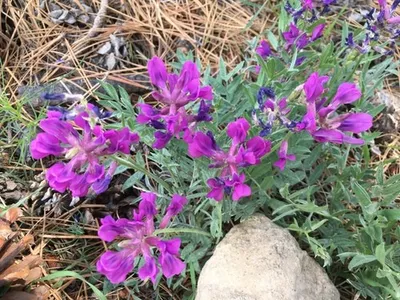
Oxytropis lamberti
Substance Background
A perennial Fabaceae legume of the North American prairies whose ingestion by livestock produces the well-known syndrome “locoism”—a progressive neuro-visceral intoxication with staring, stupor, incoordination, tremor, emaciation, abortions, and behavioural derangement [Clarke], [Boericke], [Hughes]. In homeopathy the tincture is prepared from the fresh flowering plant. Classical authors describe a central–spinal action with cerebellar ataxia, mental dullness or exaltation, and sexual–uterine disturbance (impotence; amenorrhoea; miscarriage tendency) [Clarke], [Boericke], [Boger]. Toxicological colour (later corroborated by veterinary literature) explains its keynote sensorimotor incoordination, vacant stare, slow comprehension, impulse outbursts, and reproductive failure; pathophysiologically one thinks of synaptic/metabolic poisoning of Purkinje/cerebellar systems with an overlay of autonomic dysregulation [Hughes], [Clarke].
Proving Information
No Hahnemannian full proving; the pathogenesis is compiled from fragmentary provings, toxicology (animal and human exposure), and clinical confirmations: stupor alternating with excitability, slow comprehension, vacant stare, tremor, ataxia, missteps/falls, numbness, sexual debility, amenorrhoea/abortion tendency, and dyspeptic weakness [Allen], [Clarke], [Boericke], [Boger]. Tags: [Toxicology] [Clinical] [Proving].
Remedy Essence
Essence. Oxyt. portrays toxic ataxia with a vacant stare. The sufferer stares past you, slow to grasp, then in a moment may act foolishly or with irritable impulse, only to drift back into stupor. The body moves uncertainly—feet too far apart, hands tremble on effort, steps misjudge—and this incoordination worsens with exertion, sun/glare, wind, noise, fasting, and sexual attempts, and is better for rest, support, warmth, dimness, and steady routine [Clarke], [Boericke], [Boger]. The reproductive field echoes the general atony—impotence, amenorrhoea, and abortion tendency in the cachectic—while digestion flags in atonic dyspepsia and weight loss. The psychomotor polarity (stupor ↔ silly impulse) and the ocular sign (glassy, fixed gaze) are decisive.
Differentiation. Choose Oxyt. over Gelsemium when drowsiness from fear is absent and the eye shows the vacant fixity; over Agaricus when impulsive folly alternates with stupor without much twitching; over Conium when vertigo is less positional and more cerebellar ataxia; over Helleborus when there is more motor than pure mental stupefaction; and over Agnus-c./Selenium when sexual atony is accompanied by stare, ataxia, and sun/wind aggravation [Clarke], [Boericke], [Boger], [Phatak].
Practice. Think of Oxyt. in post-intoxicant or toxic–metabolic unsteadiness, in neurasthenic country dwellers “driven silly by sun and wind,” and in adolescents with alternating blankness and foolish acts, dropping tools and missing steps. Nurse with dim light, quiet, warm wraps, steadying hands, rails, small frequent feeds, and no alcohol; once stare softens and gait steadies, constitutional remedies may follow (e.g., Kali-phos., Sepia) if residual organs call [Clarke], [Boericke], [Boger]. In women with amenorrhoea from exhaustion and vacant affect, Oxyt. may be the bridge to menses when routine and nourishment are restored. In men with impotence plus ataxia, it is preferable to the purely sexual tonics.
Affinity
- Cerebellum / coordination — Staggering, misreaching, tremor, ataxic gait, especially after exertion or excitement; mirrors locoism and reappears in Extremities/Back [Clarke], [Boericke], [Boger].
- Cerebral cortex / mind — Vacant stare, slow comprehension, alternation of stupor and silly exhilaration; impulse acts without judgment (Mind cross-link) [Clarke], [Allen].
- Optic / ocular motor — Fixed gaze, photophobia, blur on exertion, eyes glassy, tracking faulty; head pain about root of nose/occiput from strain (Eyes/Head) [Clarke], [Boericke].
- Peripheral nerves / posterior columns — Numbness, paresthesia, uncertain step, worse dark or with eyes closed (Romberg-like), better support [Boger], [Clarke].
- Reproductive organs — Impotence; sexual perversion or indifference; amenorrhoea; uterine atony; abortion tendency (Female/Male) [Clarke], [Boericke].
- Liver–digestion — Atonic dyspepsia, weight loss, weakness with aversion to exertion; links to general cachexia [Clarke], [Boericke].
- Heart–autonomic — Palpitations with exertion or emotion; erratic pulse in spells of excitement; settles with quiet (Generalities) [Boger], [Clarke].
Better For
- Quiet, dim rooms — Sensory load reduction steadies tremor and head; the vacant agitation subsides (Mind/Eyes cross-link) [Clarke], [Boericke].
- Firm support / holding rails — Improves gait and stance; patient seeks props; confirms posterior-column affinity [Boger].
- Lying on back; absolute rest — Vertigo and staggering abate; head clears slowly [Clarke].
- Steady routine; gentle pacing — Avoids post-exertional wobble and impulse acts [Boger].
- Warmth — Chilliness and muscular stiffness better for gentle heat and wraps [Boericke].
- Small, frequent nourishment — Lifts sinking and irritable spells (Stomach/Generalities) [Clarke].
- Reassuring company — Curbs impulsive folly, fearful start; steadies pulse [Clarke].
Worse For
- Exertion; riding; sudden effort — Brings staggering, tremor, missteps, and palpitation [Clarke], [Boger].
- Excitement; noise; bright light — Triggers foolish hilarity or irritable bursts; worsens stare and incoordination [Clarke], [Boericke].
- Sun, glare, wind on face — Photophobia, headache, and uncertain gait intensify (Eyes/Head link) [Clarke].
- Fasting; emaciation — Weakness magnifies ataxia; mood sinks (Stomach) [Clarke].
- Standing with eyes closed — Reeling worse (Romberg sign); needs support [Boger].
- Sexual excess / attempts — Increases exhaustion and mental vacancy; impotence marked [Boericke].
- Loneliness / monotony — Drifts to aimless wandering or fixed staring episodes [Clarke].
- Alcohol — Exaggerates incoordination and folly [Clarke].
Symptomatology
Mind
The mental picture carries a distinctive vacant–foolish polarity. Periods of stupor, slow comprehension, and a fixed, glassy stare alternate with silly hilarity, impulse acts, and irritable outbursts that the patient scarcely recalls—echoing the worse excitement/noise and better quiet/dimness modalities [Clarke], [Boericke]. Memory is poor; he forgets what he was about and wanders ineffectually. Judgment is blunted; he may attempt tasks beyond power and end in staggering, cross-linking with the cerebellar field (Generalities/Extremities). Melancholy may occupy mornings with indifference and weariness; by afternoon a restless folly appears—an alternation observed in locoed animals and humans alike [Clarke]. Fear is not vivid as in Aconite; it is an unsteady dread that he will fall or lose control, and so he seeks supports, walls, companions. The gaze is often fixed; his face immobile while the mind drifts, then a thought seizes him and he acts on it without foresight. Compare Gelsemium (dullness, tremor, ataxia from fear with drowsiness) and Agaricus (ataxia with silly laughter and twitching); choose Oxyt. when the vacant stare, aimless wandering, and reproductive atony combine under exertion/light aggravations [Clarke], [Boger], [Boericke].
Head
Head pains are dull, benumbing, with weight in the occiput and across the brow; turning quickly or facing sun/wind brings swimminess and threatens a stagger [Clarke]. The head feels empty yet heavy, a toxic stupor; noises jar and provoke foolish irritability. There is a sensation as if the eyes would not track, and using the eyes aggravates head symptoms (Eyes cross-link). Heat to the nape steadies; lying quiet restores order—this tallies with better rest/warmth. Compared to Conium (occipital heaviness with vertigo on turning) Oxyt. has more vacant staring and impulsivity; compared to Helleborus, less sopor and more ataxia.
Eyes
Eyes glassy, with a fixed, far-away look; photophobia to glare; blur on exertion; tracking is uncertain, letters seem to swerve; headache increases with light [Clarke], [Boericke]. Pupils may be dilated in spells of excitement; lids tremble on effort. The patient often narrows lids in <a href="https://www.iqhomeopathy.com/materia-medica/sol/">sunlight and walks off-line, linking the ocular to the cerebellar field (Extremities). Relief comes in dim rooms; strong wind on face aggravates watering and unsteadiness. Unlike Gelsemium’s ptosis, Oxyt. has a stare, not a droop.
Ears
Fullness and ringing during head-heaviness; startles at sudden noises which provoke tremor and irritability; prefers quiet [Clarke]. Hearing per se is not damaged; it is the sensory gating that fails under intoxication. After a day of stimulation there is roaring on lying down that subsides with sleep.
Nose
Nose dry in wind; sneezing spells after glare or dust; coryza is not a sphere of this remedy. Some patients report loss of smell in phases of mental vacancy, recovering with general improvement [Clarke]. Irritation of nares increases head confusion in sun.
Face
Face pale, expressionless in stupor; at other times silly grin or fretful twitching of lips. Jaw trembles on effort; cheeks hollow with emaciation in chronic cases. The fixed stare is a marked bedside sign that echoes the Mind/ Eyes picture [Clarke], [Boericke].
Mouth
Mouth dry when excited; saliva thin when fatigued; tongue trembles on protrusion and may deviate; speech slow, words mis-chosen when the mind wanders [Clarke]. Bitter taste with morning melancholy; a craving for small sips and bread appears during weakness. The mouth mirrors the neuro-muscular lapse.
Teeth
Grinding at night in excitable spells; teeth feel loose or numb on waking from stupefied sleep. No specific odontalgia belongs; pressure on molars may reproduce the head heaviness. The dental field is incidental.
Throat
A sense of emptiness and weak voice; on speaking long the voice breaks with tremulousness matching the systemic ataxia; cold air on throat brings cough and stagger, linking air and balance [Clarke]. No membrane or ulceration is central.
Stomach
Atonic dyspepsia with flatulence, sinking at 11 a.m., and aversion to exertion after meals [Clarke]. Fasting increases tremor and silliness; small, frequent food steadies (Better). Nausea occurs after sun and wind exposure when head swims; warm drinks relieve. Appetite may be capricious; emaciation follows long intoxication (Background link).
Abdomen
Abdomen lax, gurgling, with torpor; dull pains from diet errors; a sense of emptiness and weak belt at waist when walking, leading to missteps [Clarke], [Boger]. Portal sluggishness parallels mental and motor slackness.
Urinary
Urination infrequent with low output in stuporous days; polyuria after nervous excitement. No acute burning; sphincter control is intact though hesitant when anxious or in public (Mind link).
Rectum
Constipation from intestinal atony with scant, dry stools; effort brings vertigo and tremor; occasionally a day of relaxation when excitement has kept eating irregular [Clarke]. Rectal sphere reflects systemic weakness.
Male
Impotence, slow or absent erections, desire diminished or perverted; attempts exhaust and leave him vacant and tremulous; the sexual sphere mirrors the CNS depression [Clarke], [Boericke]. Spermatic pains dull, with a heavy sense in testes after exertion. Compare Agnus-c. (impotence with despair); Oxyt. is foolish or blank rather than despondent.
Female
Amenorrhoea or scant menses; uterine atony with sense of emptiness; abortion tendency in exhausted subjects (Clinical) [Clarke], [Boericke]. Sexual feeling is low; coitus followed by stupor or irritability. Pregnancy brings increased stare and unsteadiness in sensitive cases; nursing women grow weak after excitement. Compare Sepia (pelvic laxity with indifference and hot flushes); Oxyt. has marked ataxia and vacancy.
Respiratory
Short breath when staggering or after sudden emotion; sighing from vague dread. Cold air to face provokes cough and transient spasm—less laryngeal than autonomic. Breathing deepens in dim, quiet rooms (modal echo).
Heart
Pulse irritable, quick in excitement; soft, slow in stupor; palpitations with fear of falling or a peculiar abdominal emptiness [Boger]. No structural lesion; rhythm reflects neurotoxicity. Warmth and rest restore steadier beat.
Chest
Breathing shallow with effort; palpitation on walking quickly or facing wind; oppression accompanies tremulous spells and abates with lying quiet [Clarke]. Voice may tremble; laughing fits bring cough in silly phases. The chest shows autonomic instability.
Back
Lumbosacral weakness with uncertain step; cannot stand long with eyes closed; cervico-occipital ache from holding the head steady in glare [Boger], [Clarke]. Pressing the back to a wall restores orientation—hallmark of reliance on support.
Extremities
Ataxic gait: feet wide apart, steps ill-placed; tremor of hands on effort; numbness and tingling in distal parts [Clarke], [Boger]. Worse exertion, sun, noise; better support, rest, warmth. He drops tools; misjudges distances; in the dark reels. Compare Gelsemium (tremor with drowsy weakness), Agaricus (clownish ataxia with twitching); Oxyt. adds vacant stare and sexual atony.
Skin
Skin dry, nutrition low; sores heal slowly in the cachectic; complexion sallow. No eruptive signature; the skin displays the degenerative context (Background). In wind the face stings and eyes water, worsening unsteadiness (Eyes link).
Sleep
Sleep heavy, unrefreshing; falls into stupor after mental or emotional effort; wakes vacant with tremor on moving [Clarke]. Nights after excitement are broken by silly thoughts or restless wandering about the room, then a blank spell. Morning brings melancholy and slowness that lift by noon if undisturbed. Dreams confused, of missing the way or arriving at the wrong place—a cerebellar allegory.
Dreams
Rambling journeys, stairs misjudged, falling sideways; acts without plan and then cannot recall why—dreams mirror the impulse without judgment waking state [Clarke]. On waking, a few moments of fear of falling before balance returns with support.
Fever
Little fever; alternating chilliness and flushes after sun or excitement; sweat slight. Temperature is less a driver than neurotoxicity; patients feel cold and empty, relieved by wraps and repose [Boericke].
Chill / Heat / Sweat
Chilly in wind and after small exertion; heat of head in glare; sweat light, chiefly with palpitations. He cannot tolerate sun or dust-laden wind without unsteadiness (modal cross-links). Warm, still rooms suit.
Food & Drinks
Desires bread, simple warm foods, and small sips; fasting aggravates tremor and silliness; alcohol worsens staggering and impulse [Clarke]. Aversion to heavy fats in atonic phases. After meals seeks quiet to avoid post-prandial wobble.
Generalities
Oxyt. binds a toxic ataxia (cerebellar/posterior-column) to a vacant–foolish mind and a reproductive atony. The master pattern is worse from exertion, excitement, noise, glare/sun, wind on the face, fasting, standing with eyes closed, sexual attempts, and alcohol; better for rest, dim quiet rooms, firm support, warmth, steady routine, small frequent nourishment, and reassuring company [Clarke], [Boericke], [Boger]. This explains the bedside behaviour—hugging walls, staring, sudden foolish acts, then emptiness—and the organ echoes: ocular stare, head heaviness, palpitation with effort, impotence/amenorrhoea, digestive atony. Differentiate from Gelsemium (fear-driven drowsy tremor), Agaricus (twitchy clownish ataxia with frost-bite tendencies), Conium (vertigo and occipital heaviness without the stare and folly), Helleborus (stupor without the alternating silly facet), and Plumbum (peripheral degeneration with retraction rather than ataxic sway) [Clarke], [Boericke], [Boger], [Phatak].
Differential Diagnosis
Ataxia / incoordination
- Gelsemium — Drowsy weakness, trembling, fear; Oxyt. adds vacant stare, impulsive folly, stronger sun/wind aggravation [Clarke], [Boger].
- Agaricus — Ataxia with twitching and silly laughter; Oxyt. has more stupor and sexual atony [Boericke], [Clarke].
- Conium — Vertigo on turning, occipital heaviness; less impulsivity and stare than Oxyt. [Clarke].
- Cocculus — Seasick vertigo, nausea; Oxyt. less nauseous, more ataxic and vacant [Boger].
- Tabacum — Faint, cold sweat, violent nausea; Oxyt. lacks the pallor–collapse extremity [Boger].
Mental vacancy / folly
- Helleborus — Torpor, slow answers, stupefaction; Oxyt. alternates with silly or irritable bursts [Clarke].
- Cannabis ind. — Spaced-out, errors of time/space; Oxyt. more motor ataxia and reproductive atony [Clarke].
- Hyoscyamus — Lascivious foolishness with jealousy; Oxyt. foolishness is toxic/vacant, not dramatic [Boericke].
Sexual atony
- Agnus-castus — Impotence with despair; Oxyt. has blankness and fatigue rather than hopelessness [Clarke].
- Selenium — Weakness after losses; Oxyt. less emissions, more vacancy and ataxia [Boger].
- Caladium — Impotence with aversion; Oxyt. desires little and tires easily [Clarke].
Amenorrhoea / uterine atony
- Sepia — Pelvic laxity with irritability/hot flush; Oxyt. shows vacant stare, ataxia, sun/wind aggravations [Clarke], [Boericke].
- Pulsatilla — Mild, weepy, changeable; Oxyt. is blank or foolish, less emotional [Clarke].
- Caulophyllum — Spasmodic, painful insufficiency; Oxyt. more atonic, cachectic [Boericke].
Cachexia / atony
- China — Exhaustion from losses with flatulence; Oxyt. shows ataxia and stare as guides [Boger].
- Phosphoric acid — Apathetic exhaustion; Oxyt. adds motor incoordination and impulsivity [Clarke].
Remedy Relationships
- Complementary: Gelsemium — When fear-tremor layer overlays Oxyt.’s ataxia; Gels. calms dread, Oxyt. clears vacancy [Boger], [Clarke].
- Complementary: China — For cachexia and flatulent atony after Oxyt. steadies the nervous field [Boger].
- Complementary: Kali-phos. — Nerve tonic to restore confidence and sleep post-intoxication [Phatak].
- Follows well: Nux-v. — If stimulant excess (alcohol) exacerbates staggering; Nux for irritability, then Oxyt. for ataxia [Clarke].
- Follows well: Ignatia — After emotional shock, if vacancy and incoordination remain [Clarke].
- Precedes well: Agaricus — If residual twitch and clownish gait persist when vacancy lifts [Boericke].
- Precedes well: Sepia/Pulsatilla — When the uterine sphere needs further regulation after nervous field is steadied [Clarke].
- Related cluster: Gels., Agar., Con., Cocc., Hell., Agn-c., Sel., Sep., Puls. — select by mind-tone (vacant vs fearful vs emotional) and by motor signature [Clarke], [Boericke], [Boger].
- Antidotes (functional): Rest, dim quiet, warmth, simple nourishment; Camphor for drug idiosyncrasy [Hughes], [Clarke].
Clinical Tips
- Ataxic unsteadiness after sun/wind exposure: Vacant stare, staggering, palpitation on exertion—Oxyt.; insist on rest, dimness, warmth while dosing [Clarke], [Boericke].
- Impotence with vacancy, not despair: Attempts end in fatigue and stupor—Oxyt. over Agnus-c. [Clarke].
- Amenorrhoea in the cachectic with glassy stare: Restore routine and nourishment; Oxyt. to rouse function; follow with Sepia/Puls. if pelvic signs persist [Boericke].
- Post-exertional foolishness and missteps in youths: Teach pacing; Oxyt. clears impulsivity + ataxia [Boger].
- Dosing: Toxic–functional states respond to 6C–30C once to twice daily for short runs, then space; chronic ataxia/vacancy may take 200C single and observe; redose on relapse of the stare–stagger triad [Boericke], [Boger].
Selected Repertory Rubrics
Mind
- Stupefaction; answers slowly; vacant stare — intoxication stamp; quiet/dimness > [Clarke], [Boericke].
- Foolish behaviour; impulse acts; silliness — alternates with stupor; excitement/noise < [Clarke].
- Irritability from slight noise; sudden bursts — sensory overdrive [Clarke].
- Aimless wandering; forgets purpose — toxic distraction [Clarke].
- Fear of falling/losing control — seeks supports [Boger].
- Company, reassuring, ameliorates — steadies impulse [Clarke].
Head
- Heaviness occiput and brow; sun/wind < — toxic dullness [Clarke].
- Vertigo on exertion; must lie — cerebellar note [Boger].
- Head swims when walking in sun — glare trigger [Clarke].
- Better warm applications to nape — vascular steadier [Boericke].
- Noise aggravates head confusion — sensory threshold low [Clarke].
- Empty yet heavy feeling — toxic stupor [Clarke].
Eyes
- Gaze fixed; glassy look — keynote [Clarke], [Boericke].
- Photophobia to glare; wind < — sun/wind axis [Clarke].
- Vision unsteady; letters swerve — tracking fault [Clarke].
- Pupils dilated in excitement — autonomic echo [Clarke].
- Better in dim light — modality [Boericke].
- Lids tremble on effort — motor fatigue [Clarke].
Extremities / Coordination
- Ataxic gait; staggers; missteps — essence [Boger], [Clarke].
- Trembling of hands on effort — exertion < [Clarke].
- Numbness/tingling distal parts — posterior-column hint [Boger].
- Worse standing with eyes closed — Romberg trait [Boger].
- Needs support; holds walls/rails — better support [Boger].
- Drops tools; misjudges distance — cerebellar sign [Clarke].
Female
- Amenorrhoea from exhaustion — reproductive atony [Clarke], [Boericke].
- Uterine atony; tendency to abortion — cachectic terrain [Boericke].
- Sexual desire diminished — mental vacancy tie [Clarke].
- After exertion worse — systemic law [Clarke].
- Menses scant, irregular — functional slackness [Clarke].
- Aversion to coitus; fatigue after — inhibition [Clarke].
Male
- Impotence with mental vacancy — not despairing [Clarke], [Boericke].
- Erections weak; fatigue after attempts — exertion < [Clarke].
- Desire low or perverted — intoxication [Clarke].
- Palpitation after sexual effort — autonomic sign [Boger].
- Better rest from sexual excitement — management [Boericke].
- Alcohol aggravates sexual weakness — clinical note [Clarke].
Generalities
- Worse exertion, excitement, noise, glare, wind, fasting — master aggravations [Clarke], [Boger].
- Better rest, dimness, warmth, support, small frequent food — master ameliorations [Clarke], [Boericke].
- Emaciation with atony — cachexia rubric [Clarke].
- Palpitations with trembling — autonomic sign [Boger].
- Alternation stupor ↔ foolish hilarity — polarity [Clarke].
- After alcohol worse — clinical guidance [Clarke].
References
Allen, T. F. — Encyclopaedia of Pure Materia Medica (1874–79): fragmentary proving data; neurotoxic signs (stupor, incoordination), reproductive atony.
Hughes, R. — Cyclopaedia of Drug Pathogenesy (1870): toxicology of poisonous plants; locoism features (neuro-behavioural, reproductive) used comparatively.
Clarke, J. H. — A Dictionary of Practical Materia Medica (1900): Oxytropis (Loco-weed) clinical picture—vacant stare, ataxia, cachexia, sexual/uterine atony; modalities (exertion, sun, wind, noise).
Boericke, W. — Pocket Manual of Homeopathic Materia Medica (1901): keynotes—cerebellar ataxia, mental dullness alternating with excitement, sexual debility, amenorrhoea; relationships.
Boger, C. M. — Synoptic Key (1915): generals and modalities—support better, exertion/sun/wind worse; Romberg-like aggravation; differential scaffolding.
Phatak, S. R. — Materia Medica of Homoeopathic Medicines (1941): concise rubrics—ataxia, tremor, mental vacancy; nerve tonics (relations).
Kent, J. T. — Lectures on Homœopathic Materia Medica (1905): comparative reasoning for ataxia (Gels., Agar., Con.); generals applied here.
Farrington, E. A. — Clinical Materia Medica (1887): remedy group comparisons—toxic cerebellar states vs neurasthenic weakness.
Nash, E. B. — Leaders in Homeopathic Therapeutics (1899): clinical hints for ataxic states and sexual debility; contrasts with Agn., Sel.
Dewey, W. A. — Practical Homœopathic Therapeutics (1901): therapeutic groupings—ataxia; amenorrhoea from exhaustion; nursing measures.
Tyler, M. L. — Homœopathic Drug Pictures (1942): bedside colour—stare, silliness, unsteady gait; regimen counsel.
Hering, C. — The Guiding Symptoms of our Materia Medica (1879): corroborative notes on toxic plant states; alternating mental states and sensorimotor failure.
Disclaimer
Educational use only. This page does not provide medical advice or diagnosis. If you have urgent symptoms or a medical emergency, seek professional medical care immediately.